
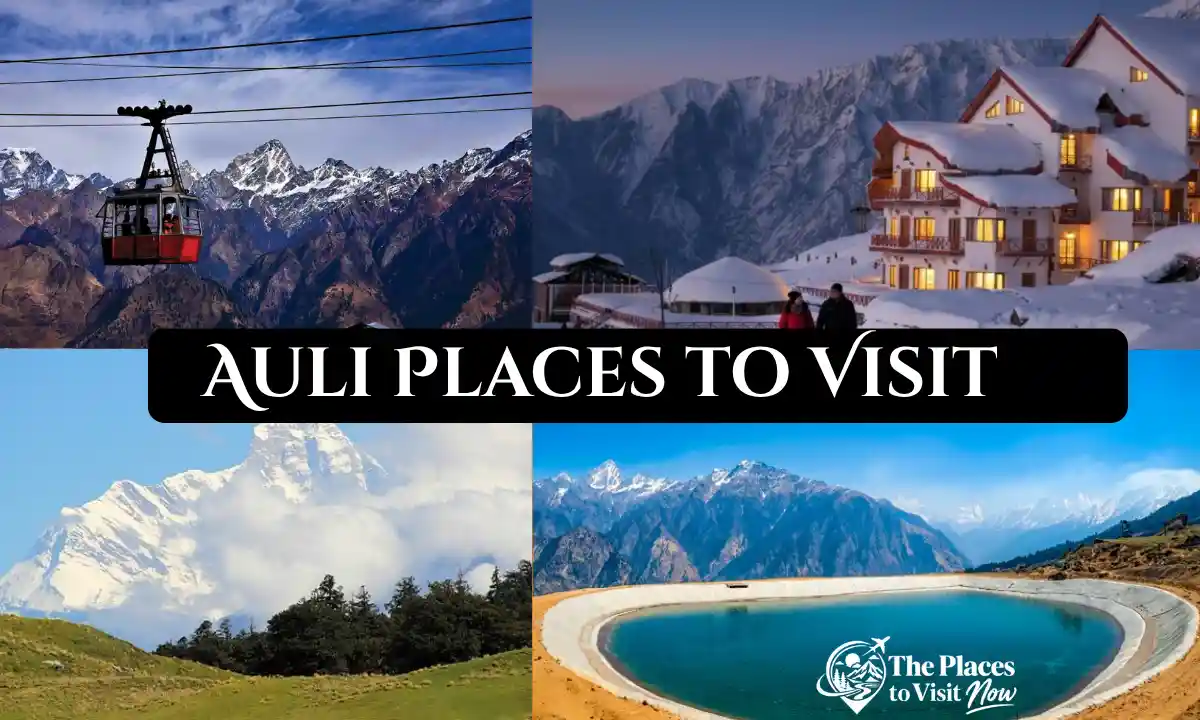
Auli is not a hill station in the conventional sense. There is no market road, no ancient church, no promenade of colonial times. Instead, there are some grassy slopes around 3,000 meters in elevation which go white in winter, with some hotels, a government-run resort, and a lift to take you up the hill.
What it has is one of the finest mountain vistas in all of India from an area that can be driven to. The highest peak in India which lies wholly within its borders, the Nanda Devi, towers just ahead of you. The vista, and the skiing, is everything there is to the area.
There is also a matter that every guide needs to be able to answer first, and that is what has occurred in Joshimath in 2023 and how it affects a visit now. This guide offers the Auli places to visit along with this question answered, the approximate prices in rupees, the treks which fill out your day off the ski runs, and the cold hard truth about the snow which cannot be guaranteed.
Auli at a Glance
| Detail | What to Know |
|---|---|
| Where | Chamoli district, Garhwal Himalaya, Uttarakhand |
| Altitude | Roughly 2,800 to 3,050 metres across the slopes |
| Base town | Joshimath, about 13 km by road or a ropeway ride away |
| Nearest railhead | Rishikesh or Haridwar, around 250 km and 9 to 10 hours |
| Nearest airport | Jolly Grant, Dehradun, roughly 270 km |
| Ski season | Roughly late December to March, peaking in January |
| Meadow season | April to June and September to November |
| Check before booking | Current ropeway status and road conditions |
| Ideal trip length | 2 to 3 nights, or a week if you are learning to ski |
| The honest truth | Snow in Auli varies year to year and is never guaranteed |
The Joshimath Question, Answered Properly
Joshimath, the town below Auli, suffered from the severe subsidence of land in January 2023. Cracks formed in various buildings and roads, people were evacuated, and the Joshimath to Auli ropeway had to stop functioning due to damage to some of its towers, according to the survey.
Let me tell what is true here, without any exaggeration. The subsidence occurred in the lower region of Joshimath town but not on the Auli slopes. The tourism in Auli still continues, hotels and the road function normally, and the information about the ropeway operation is mixed since some sources say that it works again now, and there is even a plan for the ropeway reconstruction.
This is what I would like to advise. You cannot believe whether the ropeway works or not, and you cannot think that it does not work. Check the state of the ropeway one week before your travel with the hotel, Garhwal Mandal Vikas Nigam or Uttarakhand Tourism, as it influences the trip greatly. In winter, the Joshimath to Auli road may be blocked due to snow, and when it happens together with the ropeway break, it may become hard to reach Auli.
None of this means that
Auli Places to Visit: The Shortlist
| Place | Distance | Time Needed | Best For |
|---|---|---|---|
| Auli ski slopes | On site | Half to full day | Skiing, snow play, the chair lift |
| Auli Ropeway | From Joshimath | 25 minutes each way | The approach and the views |
| Auli artificial lake | About 1 km | 1 hour | A short walk and reflections of the peaks |
| Gurso Bugyal | About 3 km trek | Half day | Oak forest and an open meadow |
| Chattrakund | Beyond Gurso | Full day | A small lake and near total quiet |
| Chair lift to the top slope | On site | 1 hour | The easiest way to the upper ridge |
| Joshimath town | 13 km | Half day | Narsingh Temple and the Jyotirmath |
| Kalpavriksha | Joshimath | 30 minutes | An ancient tree tied to Adi Shankaracharya |
| Vishnuprayag | About 12 km | 1 hour | A river confluence below Joshimath |
| Tapovan hot springs | About 15 km | Half day | Natural hot water beside the Dhauliganga |
| Badrinath and Mana | About 45 km | Full day | Char Dham temple and a border village |
| Kuari Pass trek | From Joshimath side | 4 to 6 days | One of India’s classic winter treks |
The Ski Slopes
Auli is the most popular skiing spot in India. The slopes are owned by the state tourism corporation, and there have been national and international level competitions here. It has slopes that are not difficult for beginners yet long enough to be interesting.
- There are basically two slopes; one is a smaller slope for beginners and the other one is a larger slope, which can be reached with the help of the chair lift.
- The chair lift costs around Rs 300 per person and is worth taking as it drops you at the top of the ridge where the views are at their best, irrespective of your skiing skills.
- The equipment rental service is provided right at the slopes, and the cost of renting out skis, boots, and poles ranges between a few hundred rupees and a thousand rupees per day.
- Beginner classes are available, and multi-day classes ranging from seven days to fourteen days are also organized.
- On the beginner slopes, there is a button lift or tow lift, so you don’t have to take the walk up again.
Even if you come along with non-skiers, it is alright as you can play with the snow and just enjoy
The Auli Ropeway
The gondola from Joshimath to Auli travels a distance of about four kilometres via ten towers with an altitude of approximately 3,010 metres, making it one of the longest and tallest cable car rides in Asia. It takes about twenty to twenty-five minutes to reach your destination, and the gondolas carry many people standing rather than sitting in it, and the scenic views of the oak forest and then the snow line make it worthwhile to take the gondola ride.
The price was usually about Rs 1,000 for a round trip. It can be sold out in the season, so do book your tickets either in the morning or through the online platform. As discussed above, do check whether the ropeway is operating or not before planning your visit.
The Artificial Lake
Just a short walk from the ski slope itself is an artificial lake created at a high altitude as a way of storing water for the artificial snow creation machines which make up for any lack of natural snow on the ski slopes.
It is a short 20-minute walk from most hotels in Auli, and on calm mornings, its reflection shows the tops of the mountains. In winters, it freezes up. But the importance of this artificial lake is actually symbolic as it shows you how Auli really is – a place which needs artificial snow due to the unreliability of natural snowfall.
Gurso Bugyal and Chattrakund
Above Auli the treeline opens into bugyals, the high alpine meadows of Garhwal, and these are the best non-ski hours available here.
Gurso Bugyal
Around three kilometers down from the summit of the chair lift, amidst oak trees and conifers, to a large field with an unobstructed view of the mountain range. It’s green and blooming in summer and a snow covered area in winter. This hike isn’t too hard and takes about two hours round trip.
Chattrakund
Just a few more kilometres down the road from Gurso, there is a small lake in a valley surrounded by forests. Fewer numbers of tourists make it here. It will take you an entire day to reach from Auli, and the journey should be undertaken between April and November due to difficulties in navigation through the snow.
What Am I Looking At? Naming the Peaks
Half the pleasure of Auli is the skyline, and almost nobody tells you what you are actually seeing. This is roughly what stands in front of you on a clear morning.
| Peak | Roughly | Why It Matters |
|---|---|---|
| Nanda Devi | 7,816 m | The highest mountain lying entirely within India, and a sacred peak |
| Kamet | 7,756 m | Among the highest in the Garhwal Himalaya, near the Tibet border |
| Dunagiri | 7,066 m | A steep, striking peak north-west of Nanda Devi |
| Trishul | 7,120 m | A three-summited massif named for Shiva’s trident |
| Nilkanth | 6,596 m | The pyramid above Badrinath, often the most photogenic |
| Mana and Hathi-Ghoda | Around 6,000 to 7,000 m | The ridge line closest to Auli, named for an elephant and horse shape |
Clear views are a morning phenomenon here. Cloud usually builds through the day, so if the peaks are out at seven, go and look at them rather than finishing breakfast.
Joshimath: More Than a Base Town
Most people use Joshimath as a place to rest. It is important in its own right.
- Jyotirmath: one of the four major mathas founded by Adi Shankara in the eighth century, hence the name of the city.
- Kalpavriksha: a huge mulberry tree believed to be more than a thousand years old, under which Shankaracharya was supposed to have meditated.
- Narsingh Temple: the winter abode of Badrinath. During winters, when Badrinath closes for the time being, the deity is shifted to this temple, making it the worship center for almost six months of the year.
- Vishnuprayag: one of the five holy meeting points of the river Alaknanda, located about twelve kilometers away, where the river Dhauliganga meets.
Day Trips From Auli
- Badrinath: around 45 km, one of the four Char Dham temples, generally open from late April/May till November. The drive is stunning and popular during the season.
- Mana village: beyond Badrinath, near the border, with Vyasa Cave, Bhim Pul and place from which Saraswati River comes out from the mountain. Reputedly the last village of India for ages, and now officially declared as the first one.
- Govindghat & Valley of Flowers: the starting point for this destination is some 20 km from Joshimath, and the valley is accessible between June till October. Not a day’s drive, but rather the obvious choice in summer.
- Tapovan: hot springs on Dhauliganga river around 15 km away.
Kuari Pass: The Real Adventure
If you’re healthy and you have between four and six days to stay, the Kuari Pass trek should be your main objective for being here. It takes up a part of the trail used by Lord Curzon and is one of the best winter treks in India, through meadows and forest with all the time seeing Nanda Devi and her surroundings.
It is usually done in winter for the snow or in autumn because of the clear air. Always hire a reputable operator, considering that the trail passes through unknown territory and the climate can change fast.
The Snow Is Not Guaranteed
This is the part where some of the readers will not have their holiday ruined.
Auli receives natural snowfall that can be quite variable every year. The snowfall generally starts around November and December and peaks in January and February. There is usually snow melting during March. However, there have been years when snowfall was minimal at the start of winter and visitors booked in late December found brown slopes.
- Snow-making equipment is present, but its functioning relies on temperatures and equipment usage.
- If skiing is the main goal of your visit, opt for mid-January and February, not December, and be flexible about your booking.
- Look at snowfall statistics, not seasonal statistics, as the latter does not provide any valuable information before you travel. Operators of local hotels will give you an honest answer, as no one can benefit from a displeased client.
- If sky views rather than the snow are your main aim, visit in autumn from September to November.
Costs and Tickets
These are approximate figures for planning. Rates are revised periodically, so confirm locally before you travel.
| Item | Approximate Cost (Rs) | Notes |
|---|---|---|
| Auli Ropeway return | 1,000 per person | Confirm current operating status first |
| Chair lift | 300 per person | Worth it even for non-skiers |
| Ski equipment hire per day | 500 to 1,200 | Skis, boots and poles |
| Beginner ski session with instructor | 1,000 to 2,500 | Usually a few hours |
| Multi-day ski course | 15,000 upwards | Seven to fourteen day programmes |
| Snow tubing or toboggan | 200 to 500 | Good for children |
| Gurso Bugyal guide | 800 to 1,500 per group | Recommended in snow |
| Taxi, Joshimath to Auli | 1,200 to 2,000 | One way, more in heavy snow |
| Taxi, Rishikesh to Joshimath | 6,000 to 9,000 | Nine to ten hours |
| Kuari Pass trek package | 9,000 to 15,000 | Four to six days with an operator |
| GMVN and hotel stays | 1,500 to 8,000 a night | Peaks sharply over New Year |
Best Time to Visit Auli
| Months | Conditions | Verdict |
|---|---|---|
| Mid January to February | Peak snow, coldest weather | Best for skiing, book ahead |
| December | First snowfall, festive crowds | Popular, but snow is not certain |
| March | Snow melting, still cold and clear | Good mix of snow and views |
| April to June | Meadows green, comfortable walking | Best for treks and families |
| July and August | Monsoon, landslide risk on the approach road | Avoid, the road is the problem |
| September to November | Clearest skies of the year | Best for peak views and photography |
Getting There Is the Hard Part
Auli is no weekend getaway from Delhi, however a package may make you believe.
- A distance of around 250 kilometers and nine to ten hours from Rishikesh and Haridwar via the Char Dham road passing through Devprayag, Rudraprayag and Karnaprayag.
- There are restrictions for night driving on these hill roads, but one must avoid this anyway.
- There is heavy traffic congestion on this route during the Char Dham Yatra period which extends from May to June and September to October.
- This route is prone to landslides and frequent road blocks during the monsoon season, making this the strongest argument against visiting during July and August.
- There are seasonal helicopter flights to Joshimath depending upon the weather conditions and save a day each time they are available.
Practical Tips Most Auli Guides Skip
- Auli lies at around 3,000 metres altitude and this altitude is reached quickly by road. Dizziness and breathlessness at mild levels are common during your first night there. Pace yourself and keep hydrated. Avoid drinking alcohol during night number one.
- Verify whether the ropeway is operating and the state of the roads when booking one week prior to your trip and not one month.
- Stay in Auli if you want to see the view in the morning, and Joshimath if you want more affordable accommodation and eating out options. Auli has very limited eating options outside the hotels.
- Wear proper footwear for snowy conditions. Regular trainers on slippery surfaces are responsible for most minor injuries here.
- The high altitude sun is strong despite the cold temperature. Sunglasses and sun protection are essential in this condition.
- Mobile network and cash become sparse after Joshimath. Try to withdraw money and inform your family members that you might have bad mobile reception.
- New Year week is the busiest and most expensive period of the year. Snow coverage is much better than mid-January with prices several times higher.
Trivia You Can Use to Sound Like a Regular
- Nanda Devi is the highest mountain that lies entirely within India and whose sanctuary has remained off-limits for many years to the public for conservation purposes.
- The man-made lake up in Auli was created to supply snow-making machinery, which alone explains how unreliable the natural snow in these regions is.
- The city of Joshimath derives its name from the Jyotirmath that is one of the four monasteries created by Adi Shankaracharya in the 8th century AD.
- During the closure of Badrinath, the deity of Badrinath is transferred to Narsingh Temple in Joshimath where worship continues for almost half the year.
- The gondola service that runs between Joshimath and Auli has an over-four-kilometre track with ten towers and has for long been considered one of the highest and longest cable cars in Asia.
- The Kuari Pass trek involves walking through the trail that has some connection with Lord Curzon and is still one of those Himalayan treks taken in winter.
Final Take: Check Two Things, Then Go
Places in Auli to see are limited and that’s precisely the charm of it all. The slopes, the chair lift, the artificial lake, the trek to Gurso Bugyal, and finally the backdrop with Nanda Devi right in between. Throw in Joshimath for its temples and the old tree down below and Badrinath and Mana for an extended visit during the right season.
Make sure before booking anything that the ropeway is open and the Joshimath to Auli road is passable, because only that would determine how convenient your vacation is. Choose the month accordingly. Early January to February if you were after the snow, September to November if you were after the scenery. Two or three days will do, unless you want to learn to ski or make the trek to Kuari Pass, and both of those are better reasons to be here than a weekend photo in the snow.
Frequently Asked Questio
Is Auli safe to visit after the Joshimath subsidence?
Auli tourism has been continuing after the 2023 subsidence, which took place at the bottom part of Joshimath town, and not the slopes of Auli. There have been conflicting reports about the status of the ropeway, and there is also a suggestion of reconstructing it, so you might want to check its current status, along with the road situation, before making any reservations.
What is the best time to visit Auli for snow?
The best time for snow is mid-January through February. December is a highly popular season, though the first snowfall may not always happen. Many have had to make do without snow during past years. If you prefer the mountain views over snow, visit from late September to November.
How many days are enough for Auli?
From two to three days are enough for the slopes, the chair lift, the man-made lake, and a hike to Gurso Bugyal. If you are on a skiing course, plan at least a week. For trekking Kuari Pass, four to six days are sufficient.
Is Auli good for people who do not ski?
Yes. However, the cable car ride, walking through Gurso Bugyal, the man-made lake, snow tubing, and even just the view of Nanda Devi keep visitors busy. There is no market in Auli; it is only a tourist destination without any hustle and bustle of town life.
How do you reach Auli from Delhi?
From Rishikesh or Haridwar, then by road for about 250 km and nine to ten hours to Joshimath, and thereafter by road or aerial tramway to Auli. Night journeying through the hill tracks is best avoided and the monsoon season poses a high possibility of landslides en route.
Does Auli have altitude problems?
This is about 3,000 meters up and you will get there quite fast using a car, which means that some milder reactions such as a headache and shortness of breath are expected during the first night. Take it slow on the first day.
Note: Ropeway operations, road conditions, snowfall and seasonal timings in this region change frequently and at short notice. Everything here is indicative. Confirm current status with your accommodation, Garhwal Mandal Vikas Nigam or Uttarakhand Tourism before travelling.
Also read about: Best Places to Visit in India in April: The Month the Country Moves Uphill



Leave a Reply