
Most of the city guides give you a lake, a mosque, and a couple of dams, and nothing else. It is rather strange, especially considering that Bhopal is located right in the heart of something that is extremely rare for most cities all over the world.
Within a range of just sixty kilometres, you can find cave paintings created by hunters who lived in this area before the emergence of agriculture; you can see a stupa built by Ashoka; you can study the inscription left by a Greek ambassador; you can examine the dated Gupta sculpture; and finally, you can end your trip at an eleventh-century temple that was abandoned mid-construction with everything needed to continue work on site – its construction ramp and its blueprints.
It is the last monument that makes this trip worth the effort, and we will explain why. The point of this route is the fact that the sights you have to visit around Bhopal are not randomly scattered day trips. This route is actually a timeline, and you can cover the whole thing within just two days.
The Timeline You Can Drive
Here is the full span in one table, oldest first. Read the distance column alongside the period column, and the strangeness of this region starts to land.
| Where you are standing | What period it belongs to | How far from the city |
| Bhimbetka rock shelters | Shelters lived in over 100,000 years ago, with paintings from around 10,000 BCE onwards | About 45 km southeast |
| Sanchi, the Great Stupa | Commissioned by Ashoka in the 3rd century BCE, with the carved gateways added in the 1st century BCE | About 46 km northeast |
| The Heliodorus Pillar at Besnagar | Raised around 113 BCE by a Greek ambassador from Taxila | About 60 km northeast |
| Udayagiri Caves | Gupta period, with one inscription dated to the year 401 of the common era | About 60 km northeast |
| Bhojeshwar temple at Bhojpur | Eleventh century, begun under the Paramara king Bhoja and never finished | About 28 km southeast |
What is unique about this: out of all of these sites, two are also UNESCO World Heritage Sites—Bhimbetka in 2003 and Sanchi far earlier—and are situated roughly ninety kilometres away from each other with everything else in between. Everyone does either one of them in the morning and returns to the airport.
Two Directions, Two Days
The geography turns out to be less unforgiving than it appears since the places organize themselves in two tidy lines heading opposite ways from the city.
| Which run | What it covers | Why it works as one day |
| The northeast run | Sanchi, the Heliodorus Pillar at Besnagar and the Udayagiri Caves | Sanchi and Udayagiri sit about 11 km apart, with the pillar roughly 11 km from Sanchi and 4 km from Udayagiri |
| The southeast run | Bhojpur, Bhimbetka and the Ratapani forest around them | Bhojpur is about 28 km out and Bhimbetka about 45 km, on roughly the same road |
Thus, the solution to your question regarding how many days you should allot is two, not one, and not seven. Two days, one towards the northeast, one towards the southeast, and that will do the job.
Bhojpur: The Only Temple That Shows You How It Was Built
This is the place to begin because nobody talks about this stop and it is the highlight of the area.
The Bhojeshwar temple, located in Bhojpur, some 28 kilometres away from the city was started in the eleventh century and is believed to have been built by the Paramara king Bhoja. Construction suddenly stopped and nobody knows the reason. In the course of its whole lifetime, the construction had no roof at all until it was added to it by a later restoration.
Generally, incomplete structures disappoint you. But in this case, this is what makes the structure interesting because it cannot hide its construction process due to incompleteness.
| What survives at Bhojpur | What it actually tells you |
| The earthen ramp on the northeastern corner | It runs about 300 feet long and rises roughly 40 feet, built of sandstone slabs packed with soil and sand. This is how the stone went up |
| Over 1,300 mason’s marks | Carved on the temple, on the quarry rocks and on two other shrines in the village, and they include the names of 50 masons |
| Architectural plans engraved on the quarry rocks | Detailed drawings of the finished temple, showing a complex that would have been among the largest in India |
| The lingam inside | Seven and a half feet tall and close to eighteen feet around, cut from three stacked limestone blocks, standing over 40 feet with its platform |
Stop to ponder that middle row for a while. Fifty masons inscribed their names on the construction of a building that remained unfinished close to a millennium ago and their names remain inscribed in the stone. Along with those are the sketches of what the building should have turned out to be like. There are very few places in the entire country from where one can enter into the construction site of a medieval building and study its blueprints by standing next to the ramp. Go there in the mornings and stay longer than you might feel is necessary.
The Southeast Run: Bhimbetka and the Forest Around It
Bhimbetka rock shelters
Located at around 45 kilometres south-east of the city, Bhimbetka comprises more than 750 rock shelters spanning seven hills, out of which only around 400 shelters contain prehistoric paintings. It was designated a UNESCO World Heritage Site in 2003.
The point is in the age that prevailed in this place. Certain rock shelters were occupied some 100,000 years ago. In turn, paintings belong to seven different ages – from the Upper Palaeolithic to the Mesolithic and Chalcolithic to the early historic and medieval ages, with the oldest ones dating back to the era of about 10,000 BCE. In fact, it is the surface that people used for their paintings again and again for an extremely long time period.
There is no need to visit too many shelters; thus, just take a guide if one is available because, once he shows you something to look at, the paintings become rather evident.
Ratapani, the tiger reserve most people have not caught up with
Bhimbetka’s forest belongs to Ratapani, which became the eighth tiger reserve in Madhya Pradesh in 2024. Its total area is approximately 1,271 sq km, with a core area of 764 sq km and a buffer zone of 508 sq km.
Since the area is new as a tiger reserve, the majority of touristic information regarding Bhopal has failed to update itself and considers the area a wildlife sanctuary. The rules of safari, zones, and permits at a new reserve will definitely differ from those in an old one, so better check with local authorities or the forest department instead of following an outdated route. One thing is clear: there is a protected forest near the rock art site of the World Heritage, which is quite an interesting combination.
The Northeast Run: Sanchi, Vidisha and Udayagiri
Sanchi
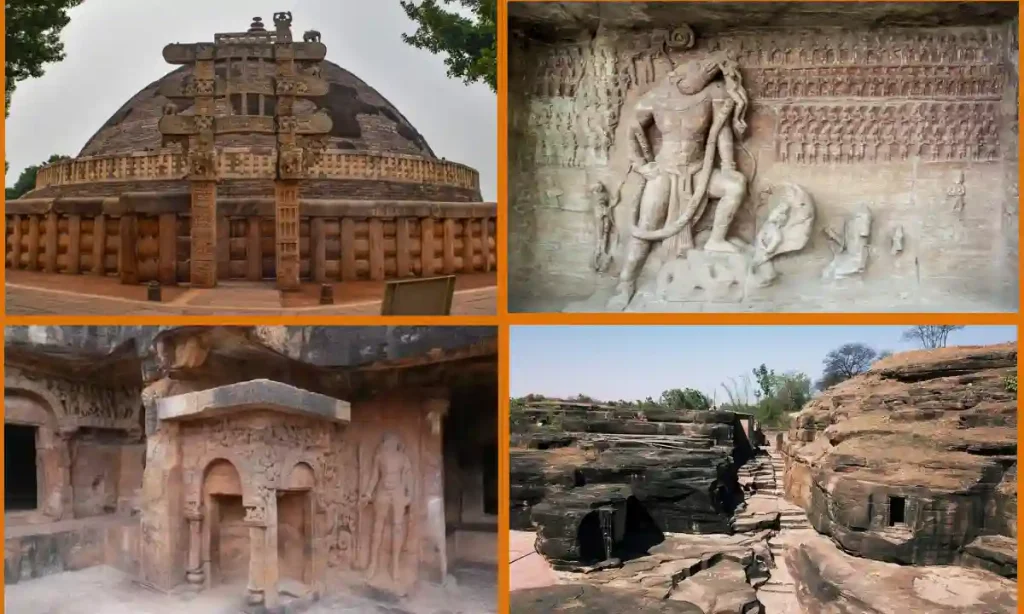
46 km away to the northeast and the most recognisable object in the area. The Great Stupa was built in the third century BCE by King Ashoka as a hemispherical brick building over the relics of Buddha. Thus, it became one of the earliest stone buildings of the country.
The four gates were erected slightly later, in the first century BCE, during the period of Satavahana rule, with the southern gate attributed to King Satakarni. The sculpture work on the gates is traditionally done by ivory sculptors of nearby Vidisha. It will be useful to remember about that while you are admiring the gates, because it will explain their detailed carving. The bottom part of the polished sandstone pillar of King Ashoka stands near the main gate with the four lions’ capital and Schism Edict now stored in the site museum.
The Heliodorus Pillar at Besnagar
Eleven kilometres away from Sanchi and four kilometres from Udayagiri, there is a stone pillar that shouldn’t be as neglected as it is.
It was erected approximately 113 BCE by an envoy of Antialcidas, an Indo-Greek king who sent him to the court of an Indian ruler named Bhagabhadra. According to the inscription, he established a standard of a bird known as garuda in honour of Vasudeva, who he calls God of Gods. It was in the fourteenth year of Bhagabhadra’s reign. Another, more concise inscription mentions three qualities that help people to go to heaven: self-restraint, charity and conscientiousness.
This artifact is the oldest extant writing devoted to Vasudeva and Krishna cults and also the first evidence of early Vaishnavism. It is sometimes said to be the evidence of the Greek convert, and the latter claim requires some consideration. Some other historians remark that Greeks usually dedicated offerings to foreign gods to benefit from their strength, and it could have been a political gesture, not a conversion. In any case, a Greek envoy placed his name on the pillar located in central India over two thousand years ago, and the stone pillar is still standing in the field.
Udayagiri Caves
There are twenty rock-cut caves belonging to the Gupta era, sponsored by Chandragupta II, comprising of nineteen Hindu caves and one Jain. This is one of the rare instances of precise dating in Indian rock-cut architecture because Cave number 6 has an inscription corresponding to 401 CE and Cave number 20 has a Jain inscription from 425 CE.
The cave that needs to be seen is Cave 5, which has a gigantic statue of Vishnu in his form of Varaha, the man-boar, rescuing the earth goddess from the cosmic ocean. This is the focal point of the entire place and it truly is enormous. ‘Udaygiri’ means the ‘mountain of sunrise’, and there have been numerous discoveries made here related to the worship of the sun.
Closer to the City
If you only have a half day off and not a whole day, then they will be closer by and will require no planning at all.
- Islamnagar, which is around 11 km away, with its palace and gardens from the early days of the Bhopal kingdom.
- The Kerwa and Kolar dams, which are both located near the city and make for an easy evening drive, but not necessarily places to visit in their own right.
- The Van Vihar, which is located within the city, near the lake shore and functions more as a rescue and rehabilitation park and not a wild forest.
- The Bhojtal lakeshore within the city, which is where Bhopal shows its best side in the evenings.
On the other hand, Pachmarhi is located around 190 km away and Ujjain is located the same distance in the opposite direction.
What the Trip Costs
Indicative rupee figures for two people. Entry charges and taxi rates both move, so confirm them before you plan a budget around them.
| What you are paying for | Roughly what it costs | Worth knowing first |
| Entry at Sanchi for Indian visitors | Around 40 to 50 per person | The site museum is usually a separate small ticket |
| Entry at Bhimbetka for Indian visitors | Around 40 to 50 per person | A guide at the gate is worth the extra and makes the paintings legible |
| Entry at Udayagiri | Small, often free or a nominal charge | Carry change; facilities here are minimal |
| Entry at Bhojpur | Usually free or nominal | The quarry rocks are outside the temple enclosure and cost nothing |
| A full day of taxi for the northeast run | 2,500 to 4,000 | Covers Sanchi, the pillar and Udayagiri comfortably |
| A full day of taxi for the southeast run | 2,000 to 3,500 | Covers Bhojpur and Bhimbetka with time to spare |
| A budget hotel room in the city | 1,200 to 2,500 a night | Bhopal has good value stock near the lakes and the station |
| A mid-range hotel room | 2,500 to 5,000 a night | Lake-facing rooms carry a premium worth paying |
| Meals per person per day | 300 to 700 | The old city is where the eating is, particularly in the evening |
When to Go
Everything on this page is outdoors and most of it involves walking on open rock, which narrows the good months considerably.
| If you come in | Here is what it is like | How it suits this particular trip |
| October to February | Cool, dry and clear, which is the best stretch of the year here | Ideal. Open rock at Bhimbetka and Bhojpur is comfortable all day |
| March and April | Warming quickly, pleasant early and hard by midday | Workable if you start at dawn and stop by late morning |
| May and June | Hot and punishing on the Malwa plateau | Avoid for the rock sites. The shade at Udayagiri helps a little, not enough |
| July to September | Monsoon, green and dramatic, with the stupa at its most photogenic | Good for Sanchi, slippery and awkward on the Bhimbetka rocks |
Two Days, Planned Properly
Day one, going southeast
Get to Bhojpur early and spend an entire one and a half hours there, most of which can be spent outdoors, looking at the ramp, the mason’s marks, and the inscribed plans. Next up, you have Bhimbetka, and you should visit this during the late morning, accompanied by a guide, spending the hottest hours of the afternoon in the shelters, since they offer shade anyway.
Day two, going northeast
First visit Sanchi early in the morning, while the lighting conditions are good on the gateway sculptures. Next, go to Udayagiri in the late morning for the Varaha sculpture. Then on to the Heliodorus Pillar, as it is not far away from here and takes only twenty minutes to reach there. Lunchtime at Vidisha, and back to the city.
Practical Tips
- Hire the vehicle for both days. There is no public transport connectivity between the sites worth mentioning.
- Hire a guide to accompany you to Bhimbetka. Without a guide, a large number of tourists would just walk by paintings without noticing them.
- Wear footwear that has grip. Bhimbetka is exposed rock, and Bhojpur is a quarry that needs some scrambling to see the good parts.
- Schedule your trips to start early. Not only will the lighting be better for the carvings, but you will get through the hottest parts faster.
- Bring with you some water and food. There will be no food to be had at either of the Udayagiri or Bhojpur sites.
- Check access to Ratapani separately from the forest department because the site is relatively new and its arrangement is being sorted out.
- Make sure to spend some time at the Sanchi site museum as the top of the Ashokan pillar is housed there.
- Always carry some money. Payment counters at these sites are not always digital.
Six Pieces of Trivia
- The incomplete temple at Bhojpur has more than 1,300 masons’ marks, and included in those are the names of 50 masons individually.
- The design for the completed structure at Bhojpur is inscribed on the stones of the quarry beside it, and described a building that would be among the largest buildings in India.
- The ramp for hoisting the stone at Bhojpur is still present, and is approximately 300 feet long, and rises 40 feet at the northeastern end.
- Bhimbetka has more than 750 rock shelters in seven hills, out of which 400 are decorated with prehistoric paintings, and were included in UNESCO list in 2003.
- The carvings on Sanchi gates are attributed to ivory carvers of Vidisha and not the stone masons.
- The Heliodorus pillar inscription gives its date to the fourteenth year of the reign of king Bhagabhadra, and mentions three virtues that would lead to heaven; self-restraint, charity and conscientiousness.
Final Take
See this as a timeline, and the geography takes on a new configuration. The best approach to visiting places around Bhopal is two days each way; one southeast to Bhojpur and Bhimbetka, another northeast to Sanchi, the Heliodorus Pillar, and Udayagiri, covering about twelve thousand years, from the early paintings to the last stone being put in place.
Do not make Bhojpur your stopover destination before moving on to something else. A temple that was left incomplete with the ramp still there, fifty names of masons on the stones, along with the design of the architecture engraved on the stones nearby is a rare sight compared to the completed structure. People usually spend twenty minutes there but give it an entire morning.
FAQ’s
What are the best places to visit near Bhopal?
Sanchi at a distance of 46 kilometers, Bhimbetka at 45 kilometers, the Bhojpur temple of Bhojpur at a distance of 28 kilometers, Udaygiri Caves and Heliodorus Pillar at Vidisha at a distance of 60 kilometers. Sanchi and Bhimbetka are both UNESCO World Heritage sites, while the most interesting feature among them is Bhojpur that was never completed and reflects its construction process.
How many days do I need for day trips from Bhopal?
The tour takes just two days and includes everything worth seeing. There are two clear sequences of sites running in opposite directions, southeast to Bhojpur and Bhimbetka, northeast to Sanchi, the Heliodorus pillar, and Udayagiri. One day is too short and you’ll be rushed through the rock art, which requires more leisurely exploration.
Why is the Bhojpur temple unfinished?
No one knows. The construction work started in the tenth century AD and was abruptly halted and no one knows why. It is precisely because of this mystery that makes this site so special. There are more than 1,300 markings made by the masons who worked on the project along with the names of 50 different masons and even the final plans of the structure are engraved into the stones at the quarry site.
How old are the Bhimbetka paintings?
The paintings are spread over seven eras ranging from the Upper Paleolithic Era to the Mesolithic, Chalcolithic, and early historical and medieval era, with the earliest dating back to approximately 10,000 BCE. However, the caves themselves have been in use for much longer, as shown by their inhabitation for over a hundred thousand years.
Can I visit Sanchi and Bhimbetka on the same day?
It is feasible but not recommended. These places are on opposite sides of the city, located 46 km northeast and 45 km southeast of the city respectively, which means that covering both of them will be a long drive with no time to spend at both places. It would be better to split them between two days.
Is Ratapani open for safari?
It became the eighth tiger reserve of Madhya Pradesh in 2024, with an area of about 1,271 square kilometres, and getting things settled for visiting a newly declared reserve normally takes some time. It is better to check the zones, permissions, and timings directly with the forest department instead of following the old maps that refer to the region as a wildlife sanctuary.
Also read more: Best Places to Visit in May in India: Up, Out or Into the Forest
Leave a Reply