
Bareilly cannot even decide on a spelling for its own name. You will encounter Bareilly, Bareli, Bareily, and Barelly, all names of the same place in western Uttar Pradesh. This confusion dates back to the founding of the place, since the town is reputed to derive its name from two brothers, Bansaldev and Bareldev. It is not possible to arrive at one name from two.
This makes a difference since the search for a list of tourist spots in Bareilly throws up a town that can be identified by four different names, and each one takes you to a different location. For the pilgrims visiting the temples dedicated to Lord Shiva, it is Nath Nagri. To those who know about the religious movement that bears the name of the town, Bareilly is Bareilly Sharif. The town that appears to anyone who has listened to the famous song from the film of 1966 is the jhumka town. Anyone interested in the history of the British colonial effort to conquer Rohilkhand knows it as the former capital of the state.
Four towns in one, and most of the guides concentrate on one and neglect the others. Here are all four in turn, and in the order in which they appear to the visitor.
First, Which Bareilly and Which Spelling
Two clarifications before everything else, since both make the mistake of taking the reader to the wrong destination.
The Bareilly in this article is the big city in western Uttar Pradesh, in the Rohilkhand region, located at the banks of the Ramganga. There is a small town called Bareli in Raisen district in Madhya Pradesh, and is completely unrelated to this place. If you used the search term Bareli and found this article, you have almost certainly found the correct location, but it is important to know that there is another.
In terms of founding, the two major reference sources disagree and it is important to make this clear. One account of the founding gives 1537, when it was founded by Jagat Singh Katehriya, a Rajput chieftain, who named it for his two sons Bansaldev and Bareldev, and the modern town was designed by Mughal governor Mukrand Rai in 1657. The other mentions the year of founding as 1537, and credits the founding mostly to Makrand Ray, the Mughal governor. The two accounts differ by almost a century and a half in who did what, with two sources that ought to know better. No one writing the tourist guide can settle this question.
Four Names, Four Different Cities
Work out which Bareilly you have come for and the rest of the trip plans itself. This is the whole article in one view.
| The name | What it refers to | Where it sends you | Time it needs |
| Nath Nagri | The ancient Shiva temples that define the old city | Alakhnath, Trivatinath, Dhopeshwarnath and the rest | A full morning |
| Bareilly Sharif | The dargah and the Islamic movement named after the city | Dargah Ala Hazrat in the old quarter | An hour, or three days at Urs |
| The jhumka town | A 1966 film song and the monument it eventually produced | The jhumka at Parsakhera, on the old NH 24 | Fifteen minutes and a photograph |
| Rohilkhand | The Rohilla capital and the 1857 rebel government | The old city, and Ahichhatra 55 km out | Half a day, or a full one with Ahichhatra |
Nath Nagri, and the Seven Nobody Can Fully List
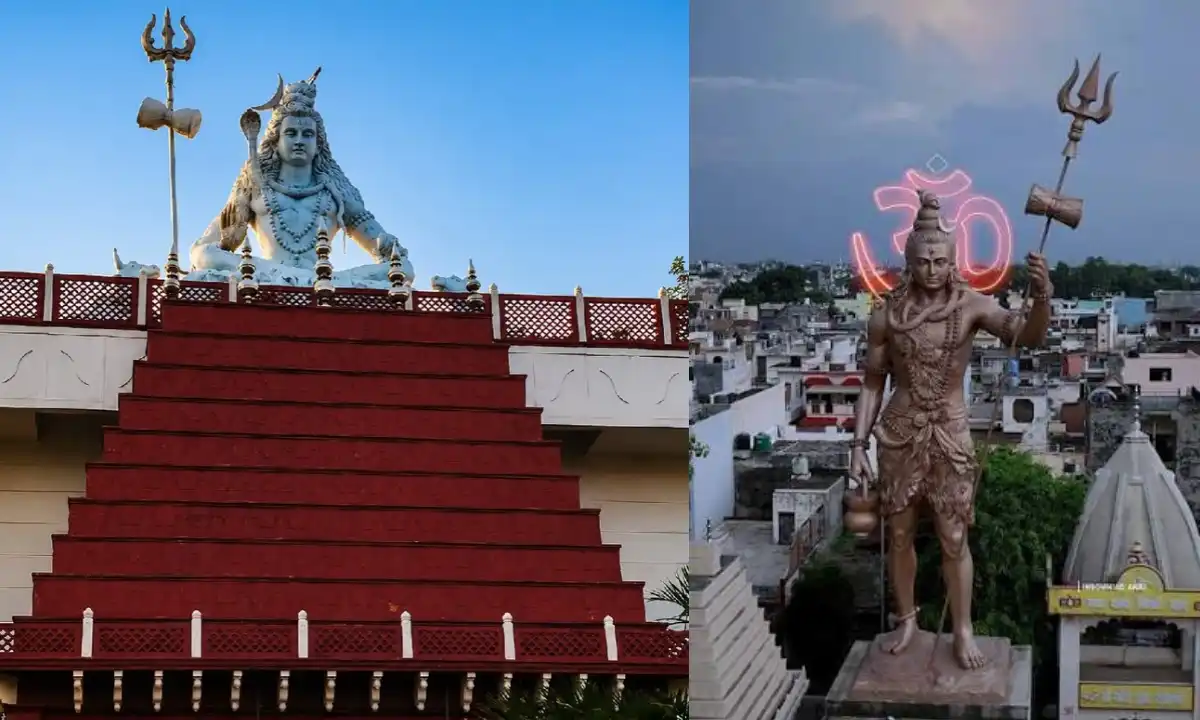
Bareilly is called Nath Nagri because of a set of ancient Shiva temples, usually described as the Sapt Nath, the seven Naths, and local accounts say they were established to guard the city from invaders. Four of them are traditionally placed at the four corners of the old town.
Here is the honest problem nobody mentions. The seven are not a settled list. A standard reference names Alakhnath, Trivatinath, Madhinath, Dhopeshwarnath, Pashupatinath and a Turant Nath temple built in 1997, and never completes the seventh. A major local newspaper covering the same seven during Sawan describes Alakhnath, Trivatinath, Dhopeshwarnath and Vanakhandinath, which is a name the reference list does not carry at all. Other listings add Tapeshwarnath and Banknath. So the city is named after seven temples and the sources cannot agree which seven they are, which is a far more interesting fact than any tidy list would have been.
What is not in dispute is that these four are the ones worth your morning.
Alakhnath
On Nainital Road near the Qila area, and the one with the longest documented history, put at somewhere above nine hundred years. The name comes from the saint Alakhiya, who is said to have done penance under a banyan here. It is the headquarters of the Anand Akhara order of Naga sannyasins, which gives it a different atmosphere from an ordinary neighbourhood temple. The local tradition is that offering water here for forty consecutive days gets your wish granted, so you will often find people mid count.
Trivatinath
In central Bareilly, and the most visited of the group. The name comes from three banyan trees, and the story is that a self manifested shivling appeared between them and was revealed in a dream to a shepherd named Mohan Chandra Gadariya. Accounts put it at around six hundred years. The custom here is to whisper your wish into the ear of the Nandi facing the shivling, which is worth watching even if you do not do it yourself.
Dhopeshwarnath
In the Sadar Bazar area of the cantonment. The name is said to have drifted from Dhumreshwarnath, after the sage Dhoomra Rishi whose ashram stood here, with a disciple installing a shivling on his samadhi. Claims about its age run to the Mahabharata period and well beyond five thousand years, and those sit in the realm of tradition rather than record. The temple pond carries a local reputation for curing skin complaints.
Vanakhandinath
At Jogi Nawada, and the one with the best story. Tradition links it to the Mahabharata and holds that Draupadi installed the shivling here, with a further legend that soldiers of Aurangzeb tried to pull it out using hundreds of elephants and could not shift it. Note that another source attaches the Draupadi connection to Dhopeshwarnath instead, so even the legends have moved between temples over the years.
Sawan, the monsoon month in the Hindu calendar, is when all of these are at their fullest and when doing several in one morning stops feeling like sightseeing and starts feeling like the thing the city is actually for.
Bareilly Sharif, the City That Named a Movement
This is Bareilly’s longest reaching section, and most Indian travel websites will allocate it precisely two lines.
The Barelvi sect, one of the largest of Sunni Islam in South Asia, is named after this city. It was founded here by Ahmad Raza Khan, taking the name of the city along with it into Pakistan, Bangladesh, Britain, South Africa, Mauritius, the United States and all across the world. Few Indian cities of its size enjoy such recognition abroad and even fewer have so many visitors oblivious of its name.
Dargah Ala Hazrat, his shrine, stands in the old part of the city and forms its centre. The annual Urs-e-Razavi festival lasts for three days, from the twenty third to the twenty fifth day of Safar in the Islamic lunar calendar, moving against the Gregorian date every year, so be sure to check the dates of the month of observation. The activities include processions, a Mehfil-e-Milad, the ablution ceremony of the dargah, scholarly lectures, dua and zikr, and the Chadar Peshi ritual of placing a cloth on the tomb.
If your visit falls on those three days, realize what you are getting into. The pilgrim flow is very large, the character of the streets in the old city changes dramatically, and this no longer becomes an occasion of visiting a modest shrine. Be ready to face it or choose some other week for your visit. In any case, dress modestly and behave according to others.
The Earring That Took Fifty Four Years to Appear
The 1966 movie song by Asha Bhosle about a jhumka lost in Bareilly bazaar, shot with Sadhana in it, is so famous that this city name became a permanent fixture of the popular culture and people living nowhere close to three hundred kilometres from the city can easily sing it.
Bareilly received absolutely nothing from this for more than half a century. Only in February 2020 Bareilly Development Authority erected a fourteen foot jhumka monument in Parsakhera on the old NH 24 road, spending altogether around eighteen lakh rupees on it, including eight lakh for the jhumka alone and ten for landscaping the area. The MP from the region opened it. Thus fifty four years after the release of the song, the bazaar got its earring.
By any normal criteria, it is an absolutely unnecessary addition to the landscape. Yet it is the only monument in the whole country built solely due to one line of a song in the film, and the constant flow of people stopping to take a picture with it proves much about the ways of a place finding its fame. Allocate it no more than fifteen minutes on the way to or out of town, and expect nothing more than that.
Rohilkhand, and the Rebel Who Minted His Own Coins
The city of Bareilly was the capital of the Rohillas, an Afghan tribe that conquered this piece of land and named this place Rohilkhand. In 1774, the ruler of Oudh gained control of this area with the help of the British in the Rohilla war and the British gained possession of Bareilly in 1801.
What happened in 1857 is what makes the place memorable. Khan Bahadur Khan Rohilla, the grandson of Hafiz Rahmat Khan, was not merely a participant of the revolt. Khan founded his own government in Bareilly and minted his own silver coins as an independent ruler. Minting a coin is something that goes far beyond hoisting a flag; it is a statement that you intend to govern. His rebellion was defeated, the city was subdued, and he himself was arrested and hanged in 1860.
There are not many monuments to mark anything that I have mentioned. You are looking at a city and keeping its past in your mind, and this is true of many North Indian cities, which does not make it any less worthwhile.
Ahichhatra, Fifty Five Kilometres and Three Thousand Years Out
In the vicinity of the village of Ramnagar in Aonla tehsil, at a distance of fifty-five kilometres from the city, lies the ancient capital of Northern Panchala, one of the kingdoms mentioned in the Mahabharata epic. There is also another name for the city – Ahichchhatra. Both names refer to the same mound. The settlement existed at least since 1000 BC. In 1871 Alexander Cunningham briefly visited the place, and later, the Archaeological Survey excavated it for about five years (between 1940 and 1945), uncovering the remains of brick fortifications and nine layers of inhabitation, covering the period from 600 BC to 1100 AD.
You should set your expectations carefully as you are about to visit a site that is most likely to disappoint visitors who expect to see something grand. Physically, all you are going to find here is an enormous mound about two miles to the west of the village, locally called the fort (Adikot), Jain temples of Parshvanatha that form an important pilgrimage center and host an annual fair in March, and a large pond at Jagannathpur, traditionally attributed to Pandavas. Much of the sculpture and terracotta excavated here can be seen in other museums but not in the location itself.
What you should come for is the scale of the site and the fact that you are standing on nearly two thousand years of inhabitation. Don’t expect to see sculpted walls.
A Warning About the Official Listing
It is so unusual that I will state it explicitly. The national tourism portal page for Bareilly contains attractions not related to the city.
First of all, it mentions Khurja Pottery Village. Khurja is in Bulandshahr district, about 85 kilometers from Delhi, and very far from Bareilly. It also lists Navalgarh Palace with frescoes and gardens, while Nawalgarh is in Shekhawati region in Rajasthan. Then it mentions Gomati river, while the river flowing through Bareilly is the Ramganga, as confirmed by standard reference sources. And, finally, it states that the city is historically known as Sanjashya and is associated with Buddha descent from Tushita, which refers to the tradition of Sankisa, which is another site in Uttar Pradesh.
The obvious conclusion is that if an itinerary for Bareilly contains pottery villages, havelis of Rajasthan or the wrong river, then it is based on that page and you should not plan your trip according to it.
What the City Actually Makes
This is an industrial city that produces goods, and its crafts are the better reason for walking through the bazaars here than any monument could be.
One of these crafts is zari and zardozi embroidery on clothing and other items and is the leading craft of the area, giving it the name of a zari town. This embroidery is along with furniture, lamp shades and basketry made with cane and bamboo and along with wooden products and goldsmiths’ work. All four crafts are listed in the state’s one district one product list for Bareilly, which boasts a sizeable artisan community, even though figures are not provided for this.
There are reports of geographical indication recognition for the wooden furniture made here and for the local zari-zardozi embroidery, which would provide artisans here with legal protection from imitation of their products outside Bareilly. These reports do not give a year or body responsible for the recognition, so consider it a report and not a dated fact and avoid repeating any year mentioned without verifying it.
Purchase from the workshops in the bazaars instead of from the showrooms along the highway and remember that the handmade product costs more than the machine product, which is why it exists at all.
Arriving and the Airport No One Expects
Trains are how most people reach the city and are the way to go. Bareilly Junction is a major station between Delhi and Lucknow, so expect plenty of options with a wide range of trains. Most people researching places to see in Bareilly find that the train is the best method of transportation since it is cheaper, more frequent and drops you close to the old city.
The surprise is that flights are available here. Regular commercial service began on 8 March 2021 using the regional connectivity scheme, with the first Delhi service operated on a seventy seat ATR 72-600 aircraft belonging to Alliance Air. The airport uses the Trishul air base, which is the property of the Indian Air Force, although the land for civil aviation operations is leased, so expect your flight to land in a shared military facility.
Do not assume the existence of flights based on route maps. Regional connectivity scheme services are added and removed depending on seasons, so make sure to check what is actually available on your dates. By road, the city sits on the old highway of the region and where the jhumka monument is, so driving to the city gets you your first sight on arrival.
The Shape of What You Will Spend
No rupee figures here. Bareilly is a city of free temples, free shrines and paid transport, which makes the spending unusually lopsided and unusually easy to predict in shape even though the amounts move.
| What you pay for | How it works | Worth knowing |
| The Nath temples | No entry charge at any of them | Offerings and prasad are your own call, and shoes come off |
| Dargah Ala Hazrat | No entry charge | Carry a head covering, and expect crowds during the three Urs days |
| The jhumka monument | Free, on a roundabout | Only cost is the detour, so pair it with an arrival or departure |
| Autos around the old city | Short hops, negotiated, or shared tempos on fixed routes | The temples are spread out, so a half day hire beats four separate rides |
| A car for Ahichhatra | Day hire, and the single biggest cost of any Bareilly trip | Fifty five kilometres each way with little to eat at the far end |
| Zari and cane work | Workshop and bazaar prices, negotiated | Hand worked zari costs more than machine work, and should |
Fitting It Into One Day or Two
The four Bareillys do not take equal time, and the sensible split is obvious once you see it written down.
| When | What to do | Why in that slot |
| Day one, early morning | Alakhnath and Trivatinath | Temples are at their best early, and the old city traffic has not started |
| Day one, late morning | Dhopeshwarnath and Vanakhandinath | Completes the corners, and they are quieter than the central two |
| Day one, afternoon | Dargah Ala Hazrat and the bazaars | The zari and cane workshops are working, and the old quarter is awake |
| Day one, on the way out | The jhumka at Parsakhera | It is on the highway side, so it costs you nothing but a stop |
| Day two, full day | Ahichhatra, out near Ramnagar | Fifty five kilometres each way makes this a day, not an afternoon |
Ten Small Facts
- After brothers it is named. Bareilly supposedly takes its name from Bansaldev and Bareldev, who were sons of the chief who founded the city, which is also an equally good reason for the confusion in its spelling.
- It lends its name to an international Islamic order. The Barelvi order was founded here by Ahmad Raza Khan and followed all across South Asia, Britain, South Africa, Mauritius and USA.
- There are no consensus views on seven Naths. The city is known as Nath Nagri for seven Shiva temples, but even the standard reference source, local newspaper and many other references provide varying combinations, none of which fully match.
- Jhumka monument comes fifty four years late. The song appeared in 1966; the fourteen-foot-high Jhumka monument was erected in Parsakhera in February 2020 for eighteen lakh rupees.
- Here a rebel issued his own currency. Khan Bahadur Khan Rohilla established a government in Bareilly during the 1857 revolt and issued silver coins as an independent ruler. He was executed in 1860.
- The water offering temple has a forty day tradition. At Alakhnath temple it is believed that offering water to the shivling for forty consecutive days makes your wish come true, thus making the queue at this temple often consists of people counting days.
- Speak to the bull at another temple. Devotees whisper their wishes to the ear of the Nandi at Trivatinath temple which faces the shivling, making them oblivious to other things going around.
- Elephants were not able to dislodge the shivling. The legend about Vanakhandinath temple says that the soldiers of Aurangzeb used hundreds of elephants to try to pull out the shivling and did not succeed.
- Panchala capital is just outside of the city. Ahichhatra, fifty-five kilometres from Bareilly, covered at least forty hectares during 1000 BCE and shows nine strata of occupations from before 600 BCE to approximately 1100 CE.
- The tourist office site does not have accurate information about the city. The site lists Khurja pottery which is in Bulandshahr district, Nawalgarh palace which is in Rajasthan; and Gomati river when Bareilly stands on Ramganga.
Things That Will Save You a Trip
- Check the dates of Urs celebrations before booking. Urs-e-Razavi happens from the twenty-third to twenty fifth Safar which changes every year in Gregorian calendar, taking the entire old city alive for three days.
- Hire a vehicle for half day and not by the temple. Both Nath temples stand at opposite ends of the old city and negotiating four autos will waste more of your time than anything else.
- Expect a full day from Ahichhatra visit and plan accordingly. This place is fifty five kilometers away from the city, majority of excavated materials are now in museums elsewhere, and what remains is a huge mound.
- Do not rely on any Bareilly itinerary containing Khurja, Nawalgarh or Gomti river. Such itinerary is copied from the official listing which includes the sites which are not in this district.
- Make Sawan your visiting month if the temples are your destination. Nath temples of Bareilly are crowded only in this month and the city looks different entirely.
- Wear appropriate clothes to the dargah and take your shoes off far in advance of the temple gates.
- Look for zari and cane crafts in bazaar workshops and not on the highway. You will get to watch the work being done and pay less than what you have paid so far.
- Identify the location of the jhumka monument as Parsakhera near old NH 24, not search the entire city center for it. It is a highway roundabout, not bazaar attraction, despite the song.
Common Doubts, Cleared
Is Bareli the same place as Bareilly?
Usually yes, since Bareli is a common spelling of the Uttar Pradesh city. There is also a separate small town called Bareli in Raisen district, Madhya Pradesh.
What are the main places to visit in Bareilly?
The Nath temples, chiefly Alakhnath, Trivatinath, Dhopeshwarnath and Vanakhandinath, along with Dargah Ala Hazrat, the jhumka monument at Parsakhera, and Ahichhatra out towards Aonla.
Why is Bareilly called Nath Nagri?
Because of its ancient Shiva temples, known as the Sapt Nath or seven Naths, which local accounts say were set up to protect the city. Sources disagree on which seven they are.
Is there really a jhumka in Bareilly?
Yes, a fourteen foot one installed at Parsakhera in February 2020, fifty four years after the 1966 song. It cost around eighteen lakh rupees including the landscaping.
How many days do you need in Bareilly?
One day covers the temples, the dargah, the bazaars and the jhumka. Add a second only if you want Ahichhatra, which is fifty five kilometres out.
What is Bareilly famous for buying?
Zari and zardozi embroidery and cane and bamboo furniture, both listed under the state One District One Product programme for the district.
Also read more: Places to Visit in Vellore: Sorted by the Time You Have
Leave a Reply