

Vizag is a doing place rather than a looking place; this is why a list of its sights does not do it justice at all. One does not admire the submarine but climbs inside it. One admires the hill from the other side and travels up to the top using a cable car. Most of the time spent here is in doing things – climbing inside somewhere or travelling up someplace, going into the water.
This page is, thus, an attempt to list the activities in Vizag in terms of the action performed rather than the place where it takes place; this way, the page will reflect reality and the way things happen in Vizag. However, there is one important thing to remember first: the two must-see attractions on the beach front open only at 2 p.m., as does the ropeway up the hill. Vizag is an afternoon town, although no one ever warns about this.
The Short Version, by What You Are Doing
Pick the verb that appeals and the day builds itself from there. Everything in this table is in or near the city, within an easy drive.
| What you do | Where you do it | What makes it worth the trip |
| Go inside | INS Kursura submarine and the TU-142 aircraft, on the beach road | You walk through a real decommissioned submarine, not a replica |
| Ride up | The Kailasagiri ropeway | A cable car to a hilltop park with the bay laid out below |
| Climb | Thotlakonda, on a hill towards Bheemili | A Buddhist monastery two thousand years old that the Navy found |
| Walk strange ground | Erra Matti Dibbalu, the red sand dunes | Coastal deposits thousands of years old, declared a geo-heritage site |
| Swim, carefully | Rushikonda, Yarada and the rest of the coast | Good water, with rip currents that have been formally mapped |
| Time your visit | Simhachalam temple | The deity is covered in sandalwood all year and shown on one day |
Go Inside a Submarine and a Spy Plane
These two face each other from the beach road, and they’re the best of the city. They are also where the afternoon clock hits hard, so make sure to get your timing right in this section.
INS Kursura
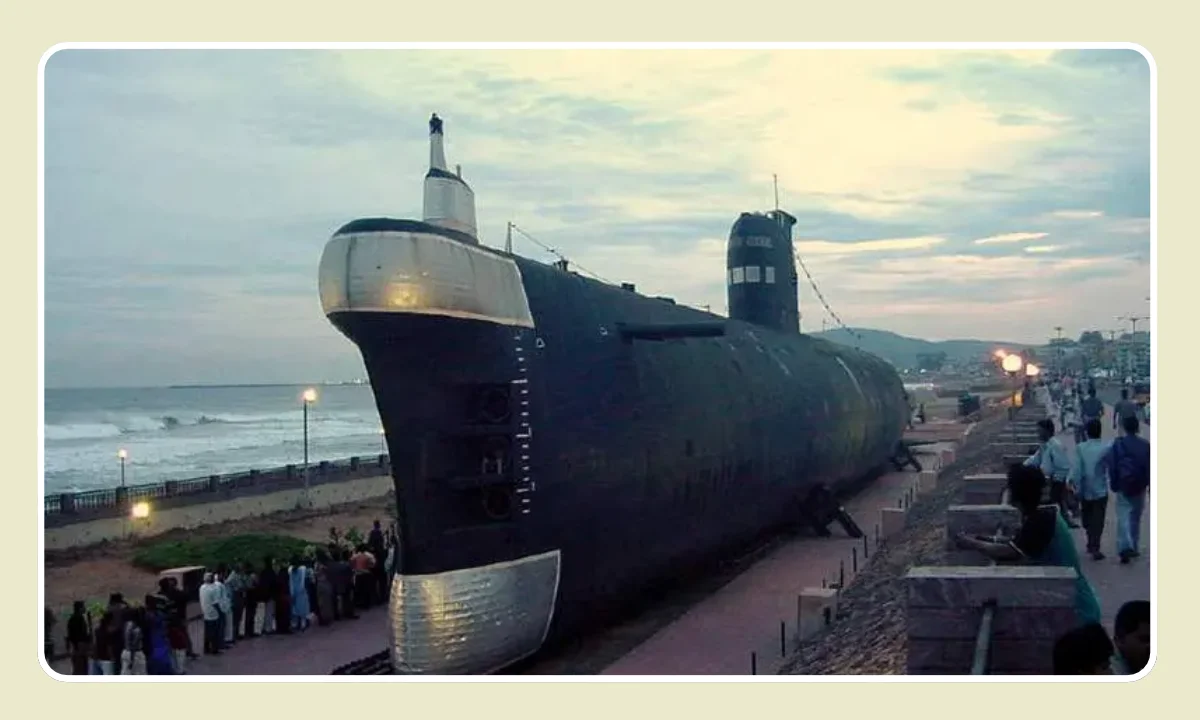
This one’s a Soviet-built submarine, commissioned at Riga on 18 December 1969 and decommissioned on 27 February 2001 after three decades of service. She was then dragged ashore and placed on a concrete platform at RK Beach. The museum opened on 9 August 2002 and was opened to the public on 24 August.
You walk through the actual hull. Control room, radar and sonar rooms, torpedo room, bunks – everything’s in its original place and original space clearance, and that’s the whole story right there. It’s a cramped space in ways that pictures cannot show you, and the thought of how people actually lived in this space for weeks at a time is the actual display. Surrounding the hull is the history of submarine technology through displays, photographs and documents.
You’ll find this stated as a first of its kind in India, or South Asia, everywhere. There’s nothing about it in the official listings or the museum documentation consulted for this page, so it’s left out here. The point beyond dispute is that it’s a real submarine to be walked through, and that’s rare enough in itself.
Opening hours, per the official listing, are from two in the afternoon till nine at night, Mondays excluded.
The TU-142 aircraft museum
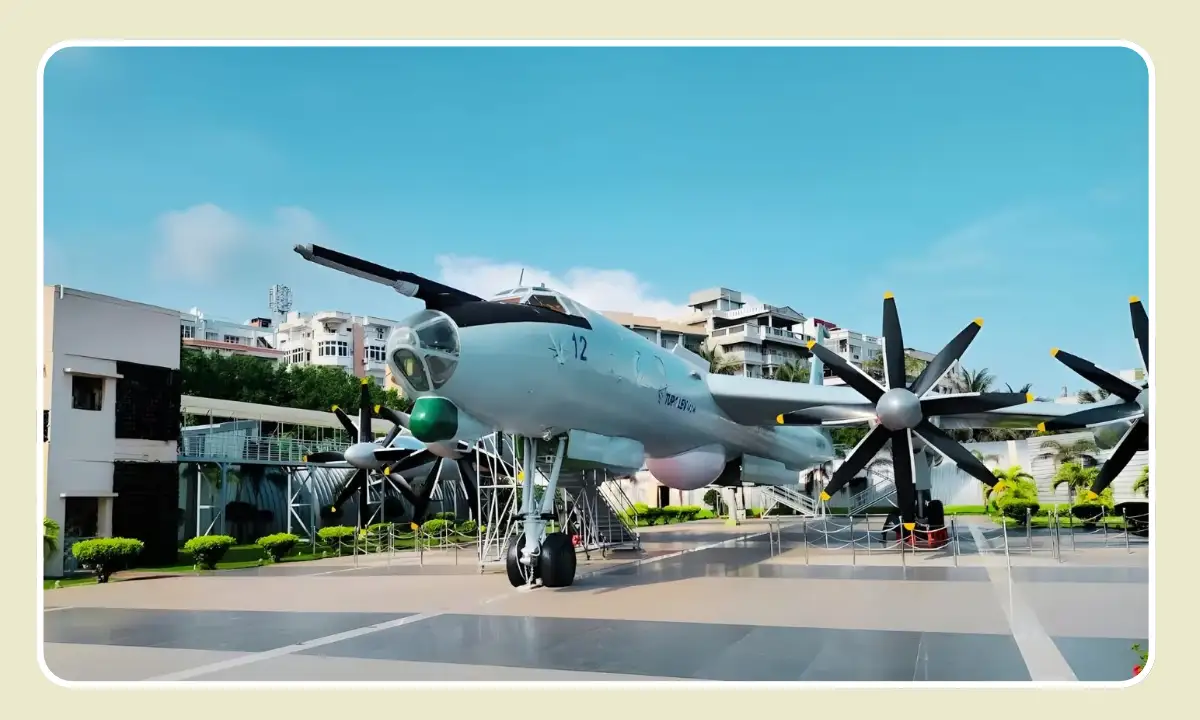
On the very opposite side, the TU-142M aircraft belonging to the Indian Navy for a period of twenty nine years, flying over thirty thousand flying hours without an accident until it was eventually decommissioned, placed in the museum that opened its doors in the year 2017.
There are survival kits, engines, data recorders, propellers, anti-submarine missiles and sonobuoys inside and around it, with explanatory notes for all these. Also, there are VR rides and flight simulators in addition to these, and as per the official listing of the museum, they are quite pricey. No photography is allowed inside the aircraft, but exterior photography is fine, and no food is allowed in the aircraft. An audio guide is included in the admission fee.
And here is where the catch lies. The two museums have facing each other on the same road, and different working timings. While the submarine is closed on Mondays, the aircraft museum is listed as open throughout the week starting from 2pm on weekdays. Weekend opening times of the aircraft museum are internally inconsistent in the official listing, so better double check them at the ticket counter.
Ride Up, and Mind the Lunch Break
Kailasagiri Park is the park on the top of the hill; and the point about the place is the ride itself. It consists of the ropeway connecting the foot of the hill with its top, toy train riding around the park at its top, roads, footpaths, and two stairways going up to the top if you do not want to use cable cars. At the top of the hill one finds the statue of Shiva and Parvati embracing each other that is forty feet high, the Shanku Chakra Namam that symbolizes conch and discus of Vishnu and is twenty feet high, shrines, gardens, open lawns, rides, and Titanic Viewpoint. The Kailasagiri Floral Festival is an annual event taking place there.
Now, some time management that I believe is very peculiar and should be noted in writing. The park operates from ten in the morning till eight in the evening. The ropeway works from eleven till one and from two till eight. So the cable car starts working one hour later than the park and works with a pause during the middle of the day. Go to the park at one-thirty with the plan of making a cable car ride, and you will see nothing happen at the bottom station.
Climb a Hill the Navy Found by Accident
Some fifty kilometres out towards Bheemunipatnam, there is an ancient Buddhist monastery complex that has only recently come to light through an aerial survey carried out by the Indian Navy while looking for a site for a naval base.
Thotlakonda was a monastery of the Nikaya school that flourished between the second century BCE and the second century CE, declined in the third century CE. It was excavated by the archaeology department of Andhra Pradesh between 1988 and 1993. The name is possibly an abbreviation for cistern hill, after the numerous rock-cut water cisterns in the area.
What sets this apart from a mere archaeological excavation site is the findings that it yielded. Satavahana lead coins and Roman silver coins, which means this hill was part of long distance maritime trade connections between Rome and the east. The monastery is situated on top of a sheltered bay where ships could anchor, it was a point where pilgrims disembarked from the ships and the tall lime-plastered stupas were perhaps used as navigation beacons by mariners. Among other artefacts there are miniature stone stupas, terracotta roof tiles, stucco fragments, carved panels, Buddha footprints and twelve inscriptions.
The main stupa structure at Thotlakonda suffered damage due to monsoons in 2019 and was renovated by 2021 at a cost of approximately forty-two lakh rupees. There is another Buddhist complex called Bavikonda which can be visited together with this one in one go.
Come early, wear proper footwear that can tackle rough terrain, take along some water with you. There is not much shade on this exposed hill top overlooking the Bay of Bengal.
Walk on Sand Far Older Than the City
There is a patch of red sand hills called Erra Matti Dibbalu around twenty kilometres along the Vizag to Bheemili beach road. It is a notified national geo-heritage monument and unlike any other coastal landscape.
In terms of age, proceed with caution. While the estimate by a geo-heritage specialist from the INTACH cell is twelve thousand years, other accounts claim these deposits record geological evolution for a significantly larger time period in numbers to match. Given the name of an expert, the latter number is preferred.
It would be better for a visitor to be aware of the problems with protection of the landmark. The decision to recognize the geo-heritage site was taken on 19 July 2014 by the Geological Survey of India, and on 7 July 2016, the state notified a total of 262 acres. However, campaigners insist that the dunes cover several hundred acres, their boundaries have never been properly mapped, and there is no fencing and no buffer zone. They claim leveling of the dunes by heavy machinery, sand quarrying, and possible inclusion into a land pooling project for constructions.
What it implies in practical terms is a rather informal access. There is a watch tower but no visitor infrastructure and some areas of ravine network may be difficult to access. Treat it as a point on the Bheemili tour route and not as a destination with an entry ticket, walk on solid ground, and do not drive over the formation.
Swim, But Know Which Water You Are In
This is the part where almost all articles about Vizag miss and this is the part where everything is serious.
Now proper research about rip currents around this coast is done. This study was conducted under the leadership of Dr. Chintam Venkateswarlu of Andhra University in collaboration with Prof. C. V. Naidu and scientists from ISRO of Ahmedabad and NCESS of Thiruvananthapuram. These studies modeled Visakhapatnam coast and found 122 days high risk, 213 days moderate risk and 30 days low risk for formation of rip currents. For RK Beach and Rushikonda, around eight hundred simulations of former and one thousand five hundred of latter were done and dangerous areas were established in both cases. Same article talks about four hundred deaths on these two beaches.
Risk is connected to direction from which waves are coming. At RK Beach risk of rip currents is high if waves are approaching at 110 to 180 degrees and at Rushikonda if waves are approaching at 40 to 170 degrees. This is definitely not something you would measure while on holiday which is exactly why swimming only where there are lifeguards and red flags is the right choice.
Rip current is a narrow stream of fast water going from shore to open sea. It is invisible from the beach which is why it is dangerous for tourists and not locals.
So, having all this in mind, let’s see how the beaches compare.
| Beach | What it is good for | What to keep in mind |
| RK Beach | The promenade, the evening crowd, the two museums | Modelled as a persistent rip current zone, so treat the water with respect |
| Rushikonda | The main swimming and water sports beach | Also modelled as a danger zone, so stay inside the patrolled stretch |
| Yarada | A quieter cove with a hill backdrop, good for a drive | Further out and less supervised, which matters more than the view |
| Bheemili | A long calm stretch at the end of the beach road | Pairs naturally with Thotlakonda and the red sand dunes |
The Deity You Can See on One Day a Year
Simhachalam, up on a hill north of town, houses Sri Varaha Lakshmi Narasimha Swamy, and it does something unique among temples that few others can match.
The deity is not visible for nearly the whole year, as the image is covered in a thick layer of sandalwood paste and all that devotees see is the sandalwood figure. It is uncovered just once a year, on Chandanotsavam, which takes place on the third day of the month of Vaisakha and is associated with Akshaya Tritiya. It marks the Nija Roopa Darshanam, or the true form.
On that particular day, the hereditary trustee has the first darshan of the image, and it remains open until eleven at night. After the Sahasra Ghatabhishekam, the first coat of the sandalwood paste is applied again, and it becomes invisible again. Lakhs of devotees come for it.
So, there are two distinctly different options available to you. You can visit Simhachalam at any time during the year and see the hill temple with great architecture and a sandalwood-covered figure, which is definitely worth a visit. On one particular day during the month of Vaisakha, you get to see the original deity along with thousands of people visiting it. You need to decide beforehand what kind of experience you want as no amount of planning on the day of the visit will help you change that.
What This Page Does Not Say About Araku
There are two attractions from Vizag that everyone should do, which this page does not cover at all. There is a reason for that, and it should be known as well.
The train journey to Araku Valley with the tunnels and bridges of the Eastern Ghats, as well as Borra Caves, are completely different from the city attractions. For them, you need an early start, and ideally, an overnight stay. The journey is the main thing, and trying to incorporate these two sights in a city itinerary leads to many people coming to Vizag only to drive to Araku and miss the whole point of doing this. Read the dedicated guide before booking anything, and definitely choose the train journey.
Everything else on this page can be seen from the city without a pre-booked ticket.
The Afternoon Problem, All in One Place
Vizag opens very late, and this fact alone reorganizes the priorities in Vizag completely. Put these together before planning your morning, as four best sights here close or have breaks at the time most tourists visit them.
| Where | When it is open | The trap in it |
| INS Kursura submarine | Two in the afternoon to nine at night, closed Mondays | A morning visit to the beach road finds the main attraction locked |
| TU-142 aircraft museum | From two in the afternoon on weekdays, open all seven days | It is open on the Monday the submarine opposite it is closed |
| Kailasagiri park | Ten in the morning to eight at night | The park is open before the ropeway is, so you may be walking up |
| Kailasagiri ropeway | Eleven to one, then two to eight | The hour long midday break strands people at the bottom station |
| Simhachalam | Open through the year, true form on one day only | The thing the temple is famous for is invisible on 364 days |
| Erra Matti Dibbalu | Informal access, no ticketing or real infrastructure | No fencing or facilities, so it is a stop rather than a visit |
Where the Money Goes
No rupee figures for tickets on this page. Museum and ropeway rates here are revised without notice and the published numbers already disagree between listings, which tells you how much weight to give any of them. The structure of the spending does not move.
| What you pay for | How it is charged | Worth knowing |
| The submarine museum | A small ticket per head, with a lower rate for children | Guided tours, school programmes and photography are listed facilities |
| The aircraft museum | A separate ticket from the submarine, including an audio guide | The virtual reality rides cost extra and the listing calls them pricey |
| The Kailasagiri ropeway | A return fare per person, separate from park entry | The toy train and the rides at the top are charged on their own |
| Beach water sports | Per activity at Rushikonda, negotiated on the sand | Agree the price and the duration before anyone starts an engine |
| A car for the coast road | Day hire, and the biggest single cost of a Vizag trip | One hire covers Thotlakonda, the dunes and Bheemili in a loop |
| Simhachalam darshan | Free general queue with paid faster options available | Expect very long waits on Chandanotsavam whatever you have paid for |
Seven Things Worth Knowing
- Thotlakonda Monastery dates back to two thousand years. An ancient monastery was spotted in a Vizag aerial survey carried out by the Indian Navy to establish a naval base. Archaeologists from the state excavated it between 1988 and 1993.
- Vizag Hilltop yielded Roman Coins. The excavation revealed Satavahana lead coins and Roman silver coins, confirming that the site played a role in long distance maritime trading when it flourished.
- The Stupas could have acted as beacons. The lime-plastered stupas located atop the hill were supposed to have acted as landmarks to sailors navigating towards the protected bay.
- The submarine was put in service and then retired after over three decades. INS Kursura was commissioned in Riga on 18 December 1969 and retired on 27 February 2001. It was opened as the museum in 2002.
- The aircraft had no accident in over thirty thousand hours. The TU-142M parked alongside the submarine served the Indian Navy for twenty nine years. It retired in 2017 and became a museum.
- The deity at Simhachalam is covered up all year except one day. The idol is kept covered with sandalwood paste throughout the year and uncovered only on Chandanotsavam on the third day of Vaisakha until eleven.
- Visakhapatnam Coast faces rip current danger on 122 days. ISRO and NCESS scientists conducted research in collaboration with Andhra University to identify Visakhapatnam coastline as having 122 high risk, 213 moderate risk and 30 low risk days.
Worth Sorting Beforehand
- Dont allocate morning time to the beach road. The submarine and the aircraft open at two in the afternoon, so the first half can go to the hills, the dunes or the temple.
- Avoid Monday visits to the submarine. The aircraft museum right across the road operates seven days a week. So, a visit on a Monday leaves you one of the two and not both.
- Move past the ropeway shutdown. The ropeway operates between eleven and one and two and eight, so you would have to wait or walk if you reach there between one and two.
- Be cautious about rip currents at RK Beach and Rushikonda. Rip currents at RK Beach and Rushikonda have been modelled as persistent danger zone and invisible from the beach.
- Check the Chandanotsavam date before booking if the true form at Simhachalam is what you have planned. Chandanotsavam takes place on the third day of Vaisakha.
- Combine the coast road into one loop. All three, namely Thotlakonda, Red Sand Dunes and Bheemili, lie on one and the same coast road, so one hire car covers all.
- Make early visits to Thotlakonda. This is because it is an unprotected hilltop with bare land and scarce shade.
- Handle the red sand dunes carefully. This is an unprotected site already suffering from quarrying and construction. Visitors getting on top of the formations through driving make the problem worse.
- Plan Araku separately and by train. This is because Araku is a whole day tour and the rail journey itself is the attraction point.
Before You Book, Quickly
What are the best things to do in Vizag?
Walk through the INS Kursura submarine and the TU-142 aircraft on the beach road, ride the Kailasagiri ropeway, climb Thotlakonda, and see Simhachalam. The red sand dunes and Bheemili round out a coast road loop.
What time does the submarine museum in Vizag open?
The official listing gives two in the afternoon until nine at night, and it is closed on Mondays. A morning trip to the beach road will find it shut.
Is the Kailasagiri ropeway open all day?
No. It runs from eleven to one and then from two until eight, with an hour long break in between, while the park itself is open from ten.
Can you swim at Vizag beaches?
Yes, but only where lifeguards are posted. Rip currents at RK Beach and Rushikonda have been modelled as persistent danger zones and are hard to spot from the shore.
Why is the Simhachalam deity covered?
The image is kept under sandalwood paste all year and revealed only at Chandanotsavam, on the third day of Vaisakha, when it stays visible until eleven at night.
How old is Thotlakonda?
It peaked between the second century BCE and the second century CE and declined by the end of the third century CE, so the complex is around two thousand years old.
Are the red sand dunes worth visiting?
As a short stop on the Bheemili drive, yes. There is no ticketing, fencing or visitor infrastructure, so do not plan a half day around them.
Also read more: Things to Do in Palampur: The Tea, the Temple and After



Leave a Reply