
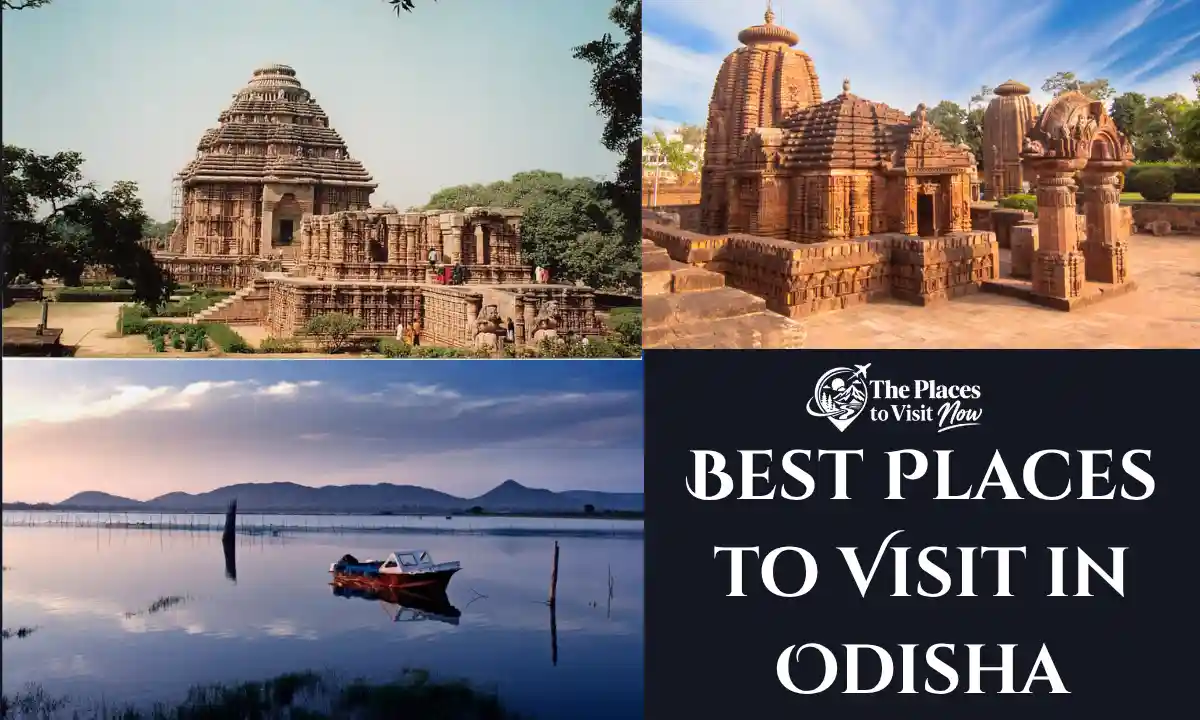
Every tour of Odisha you come across would include Bhubaneshwar, Puri, and Konark. These places are worth it, they all lie within a span of seventy kilometers and you can cover them in three days.
But this is just a tiny part of what Odisha has. It is home to Asia’s largest lagoon which has dolphins living in it and is visited by thousands of migratory birds. It has mangrove forests that have the largest saltwater crocodiles of India besides beaches that become one of the most unique spots for mass turtle nesting. It has forests which house black tigers and there are beaches where the sea moves back several kilometers during low tide, and there is even a place where Ashoka stopped warring.
This guide helps you find best spots to visit in Odisha throughout the state along with approximate entrance fees in rupees, temple entrance entry policy that catches many tourists unaware, and the seasonal calendar that makes you decide why are you visiting – turtles, birds or waterfalls.
Odisha at a Glance
| Detail | What to Know |
|---|---|
| Capital | Bhubaneswar, often called the temple city of India |
| UNESCO site | Konark Sun Temple, inscribed in 1984 |
| Best season | October to February, with November to January ideal |
| Cyclone risk | Highest on this coast in October and November, and again in May |
| Ideal trip length | 3 days for the classic circuit, 7 to 10 for the state |
| Main airport | Biju Patnaik International, Bhubaneswar |
| Temple entry rule | Jagannath at Puri and Lingaraja at Bhubaneswar admit Hindus only |
| Turtle season | Mass nesting typically falls between February and March |
| The rarest thing here | Simlipal’s melanistic tigers, found nowhere else on earth |
| Most overlooked | The Buddhist sites at Ratnagiri, Udayagiri and Lalitgiri |
The Temple Entry Rule to Know Before You Book
That will be even more important to some readers of this guidebook than anything else and is always footnoted somewhere else.
Neither the Jagannath Temple in Puri nor the Lingaraja Temple in Bhubaneswar allows entry to non-Hindus. This has been going on forever and will go on ever after because non-Hindus are kept out at the entrance.
There is a raised platform outside the boundary wall of Lingaraja where you can have a good look at the temple complex. This is the usual alternative and serves its purpose well.
In the case of Jagannath in Puri, you can admire the temple from outside as well as along the Grand Road surrounding the temple during Rath Yatra, when the deities are taken out and everyone can see them.
The other magnificent temples in Bhubaneswar, Mukteshwar, Rajarani and Parasurameswara are archaeological sites rather than functioning temples and are open to all.
If you are here for temple architecture and not worship, Bhubaneswar should be the place to focus your visit on. There is nothing you cannot see there.
Best Places to Visit in Odisha: The Master Shortlist
| Place | Region | Why Go | Time Needed |
|---|---|---|---|
| Konark Sun Temple | Coastal | A UNESCO stone chariot with 24 carved wheels | Half day |
| Bhubaneswar temples | Coastal | Six centuries of Kalinga architecture in one city | Full day |
| Puri | Coastal | Jagannath Dham, a wide beach and Rath Yatra | 1 to 2 days |
| Dhauli | Near Bhubaneswar | Ashoka’s edicts on the Kalinga battlefield | 2 hours |
| Udayagiri and Khandagiri | Bhubaneswar | Jain rock-cut caves from the 2nd century BCE | 2 hours |
| Ratnagiri and Lalitgiri | Jajpur area | Odisha’s Buddhist Diamond Triangle | Full day |
| Chilika Lake | Coastal south | Dolphins, birds and Asia’s largest brackish lagoon | 1 to 2 days |
| Bhitarkanika | Coastal north | Mangroves and India’s largest saltwater crocodiles | 2 days |
| Gahirmatha and Rushikulya | Coast | Mass olive ridley turtle nesting in season | Seasonal |
| Simlipal | Northern hills | Black tigers, waterfalls and dense forest | 2 to 3 days |
| Chandipur | North coast | The sea that recedes kilometres at low tide | Half day |
| Raghurajpur | Near Puri | A living crafts village of pattachitra painters | 2 hours |
| Daringbadi | Kandhamal hills | Coffee, pepper and cool highland air | 2 days |
| Koraput and Deomali | Southern highlands | Tribal Odisha and the state’s highest peak | 3 days |
| Cuttack | Central | Silver filigree and the Bali Jatra fair | 1 day |
Bhubaneswar: Six Centuries of One Architecture in a Single Afternoon
The term “Temple City” is applicable to Bhubaneswar, and there is a common myth that there were hundreds of temples in the past. The uniqueness of Bhubaneswar does not lie in the number of temples but rather in the process of the evolution of one particular architectural style through the existing temples.
This particular Kalinga architectural style was developed for about six hundred years and visiting the temples in chronological order will allow one to observe how the tower becomes higher, the carving more intricate and the plan larger temple after temple.
| Temple | Roughly | What Changed |
|---|---|---|
| Parasurameswara | 7th century | Early and small, with a low tower and a flat-roofed hall |
| Mukteshwar | 10th century | The turning point, with a carved stone gateway that is the finest thing in the city |
| Rajarani | 11th century | A clustered tower and superb figure sculpture, and no longer in worship |
| Lingaraja | 11th century | The full-scale version, over 50 metres tall, and the style at its peak |
| Ananta Vasudeva | 13th century | Late Kalinga, and unusually dedicated to Vishnu rather than Shiva |
Follow that order when taking them. Mukteshwar is the memorable one due to the presence of an arched stone gateway called the torana along with a tiny stepped tank. Rajarani is the choice of photographers as it is a lone structure set in a lawn.
Udayagiri and Khandagiri caves
The twin facing hillocks on the outskirts of Bhubaneswar, which have many rock-cut caves, hewn out of solid rocks for Jaina monks starting from about second century B.C.E. The cave named “Hathigumpha” or Elephant Cave, has an extensive inscription of Kharvela dynasty and forms one of the most significant epigraphic sources of early Indian History. Rani Gumpha or Queen’s Cave is the biggest and the most ornate cave here. Spend at least two hours.
Konark: What You Are Actually Looking At
Konark Temple was built in the 13th century by King Narasimhadeva I of the dynasty of Eastern Gangas and represents a gigantic stone chariot of the Sun god with twenty-four wheels along its base and seven horses drawing it. Its wheels function as sundials, and a guide will show you how to read the time using the shadow.
The following piece of information will be useful to know before coming here. The main structure, the great shrine tower that stood above all others, collapsed. What remains today is largely the jagamohana, which is the assembly hall of this temple and was filled up with sand inside by the order of the Archaeological Survey of India in the early twentieth century to prevent its collapse. You can enter only the porch of it.
This knowledge will enrich your visit here. You see the porch of the temple whose main tower was undoubtedly much higher, and this ruin scale is what matters. The sailors navigating in the Bay of Bengal used this temple as a landmark calling it the Black Pagoda, compared with the White Pagoda of Puri.
Entry fee for Indian citizens will cost Rs 40 and for foreigners – Rs 600. ASI museum next to the temple contains sculptures taken from the area of the complex. It is better to come in the morning because it is quite hot on the stone floor of the temple and the shadow here is scarce.
Dhauli: The Battlefield That Changed Indian History
The site of the Kalinga War in the third century BC lies eight kilometres away from Bhubaneswar, at a site on a small hill overlooking the Daya river. It was the horror of the massacre at this place that changed Ashoka from being a conqueror to becoming a Buddhist, and its repercussions reached right across Asia.
His edicts on rocks are inscribed at this site, with an elephant rising above them. At the top of the hill lies the Shanti Stupa, or the peace pagoda, which was constructed in the 1970s with Japanese collaboration. It offers a panoramic view of the river valley.
It will take two hours, including travel time, and those are the two most historically significant hours you can spend near Bhubaneswar. It is not included in any tourist package.
The Buddhist Diamond Triangle
The Buddhist legacy of Odisha is considerable and virtually untouched by tourists. Three monasteries that have been excavated north of Bhubaneswar, in the Jajpur region, are referred to as the Diamond Triangle.
- Ratnagiri: the most spectacular of the three, featuring a large monastery, beautifully carved doors, stupas and a museum. Situated on a slight rise and offering fine views.
- Lalitgiri: one of the oldest Buddhist centers in the area, where a relic box was discovered inside a stupa. Its own museum.
- Udayagiri: the largest excavated site of the three, not to be confused with the Jain caves of the same name near Bhubaneswar.
All three can be visited in a single day from Bhubaneswar with a hired car. Take water and prepare for little company.
Chilika Lake: Which Side Should You Actually Go To?
Chilika is Asia’s largest brackish water lagoon and it is enormous, which is why the single most useful question is which part of it to visit. The three access points offer completely different experiences and people regularly pick the wrong one.
| Access Point | What You Get | Best Season | Go Here If |
|---|---|---|---|
| Satapada | Irrawaddy dolphins and the sea mouth | November to February | Dolphins are the priority |
| Mangalajodi | Marshland birding by small boat, thousands of birds | November to February | You care about birds at all |
| Rambha and Barkul | Open water, islands, boating and resorts | October to March | You want a relaxed lake stay |
Mangalajodi merits a section unto itself. Once a place renowned for bird poaching, many of the very same families have turned around over the past several decades, working to protect the birds as boatmen and guides for tourists. Early morning trips out on a shallow river craft among the tall reeds, with a guide who can identify all the species, make for some of the most fulfilling mornings in eastern India.
On dolphins: one honest point. Some of the Satapada boat operators will actually chase after Irrawaddy dolphins to ensure a sighting, stressing the animals in the process. Choose a boat operator that maintains a distance and shuts off the engine.
Bhitarkanika and the Turtle Calendar
The Bhitarkanika Wildlife Sanctuary is a very dense mangrove ecosystem located within the Kendrapara District, criss-crossed by several creeks and can be visited in a boat. It contains one of the largest concentrations of saltwater crocodiles in India, including some huge ones, water monitor lizards, kingfishers, and an important heronry.
Adjacent to it is the Gahirmatha beach that is considered one of the world’s top mass nesting beaches for the olive ridley turtle. Mass nesting of these turtles occurs from a hundred thousand to two hundred thousand females and usually takes place in the period from February to March, but annually differs according to sea and weather conditions.
- Nesting sites are guarded and visitors can enter only upon approval of the forest department or by authorized agencies.
- Flashlights or torches must not be used while visiting nesting beaches. The artificial lights confuse hatchlings and cause their deaths due to that.
- Dates cannot be fixed prior with confidence. In case your purpose of visit is turtles, leave your schedule flexible.
- Bhitarkanika is normally off limits for a certain period during monsoons as well as during the breeding season of crocodiles.
Simlipal: The Only Black Tigers on Earth
Simlipal National Park, located in the northern district of Mayurbhanj, is a big forest filled with sal and meadow, waterfalls, elephants, and gaur. The thing that makes it a truly unique place in the world is the tigers.
A portion of the Simlipal tigers are pseudo-melanistic, which means that their stripes are so broad and fused together that the tiger appears to be completely black. It is the result of genetic mutation and the Simlipal forest contains the only population of such tigers on Earth. There is almost zero chance to see one, but the fact that they live in this forest only is amazing.
Besides the tigers, Barehipani and Joranda are among the tallest waterfalls of India, and the trip through the national park is amazing. You need permits to visit it and it is seasonal, so make sure to plan in advance.
Chandipur: The Sea That Walks Away
Chandipur on the coast close to Balasore does something that no other beach in India does. When the tide is out, the sea pulls back over a few kilometers, leaving a huge, flat seabed that you can traverse. After some time, it returns.
Thus it is dependent solely on the tides. Go to the beach at the wrong time, and you either find yourself on just an ordinary beach or a trek that you might be unable to make it back through. Ensure that you know the tides of the day before heading over, don’t venture out too far, and watch the kids.
Inland and Highland Odisha
- Daringbadi, situated in the Kandhamal hills, is touted as the Kashmir of Odisha, which is quite an exaggeration but the place is definitely cool and green and cultivated with coffee, pepper, and turmeric. It is an ideal two-day breakaway destination from the coastline.
- Koraput and Jeypore in the southern highland range boast the highest peak of Deomali in the state, Duduma waterfall, and some of the best scenery of Odisha.
- The Satkosia, where the Mahanadi cuts a long gully through the hills, offers camping by the river, and a completely different form of silence.
- The Hirakud, situated near Sambalpur, is one of the longest earthen dams in the world, with a lake large enough to have its own horizon.
- Debrigarh, which borders the Hirakud lake, is now one of the best wildlife sanctuaries in the state for animal viewing.
Now a few words about tribal tourism, considering that Koraput and the southern districts are largely advertised for the same. The weekly markets of these districts are real markets, not just shows. Use the services of a credible operator, seek permission before taking photographs of anybody, do not distribute money, candies, or tobacco, and always buy directly from producers, if at all you decide to buy. Many of the tribal tours of this district do not qualify by this criterion.
Crafts, Cuttack and the Coast
- Near Puri, there is a craft village known as Raghurajpur that is known for pattachitra paintings done on the prepared fabric, which almost all the families practice. Raghurajpur is also said to be the birthplace of Gotipua dance. Buy directly from the creators.
- On the road between Bhubaneswar and Puri, you will find the Appliqué village whose street has brightly sewn canopies, umbrellas and lampshades.
- Cuttack is the center of Tarakasi, a silver filigree work done by drawing the silver wire into lace work.
- The Bali Jatra at Cuttack celebrated at the time of Kartik Purnima in November celebrates Odisha’s ancient maritime trade in Bali and Java. This fair is one of the biggest outdoor fairs in Asia.
- Puri beach is very wide and busy, especially in the morning and Konark Marine Drive is one of the good coastal drives of India.
Entry Fees and Ticket Prices
These are approximate figures for planning. ASI, forest and state rates are revised periodically, so confirm at the counter before you visit.
| Place or Activity | Approximate Cost (Rs) | Notes |
|---|---|---|
| Konark Sun Temple | 40 Indian, 600 foreign | ASI site, museum ticketed separately |
| Konark ASI museum | Nominal | Closed on Fridays |
| Udayagiri and Khandagiri | 25 to 40 Indian | Little shade, go early |
| Ratnagiri and Lalitgiri | 25 to 40 each | Site museums included or nominal |
| Rajarani Temple | 25 to 40 Indian | No longer an active temple |
| Mukteshwar and Parasurameswara | Free | Dress modestly |
| Lingaraja viewing platform | Free | Non-Hindus cannot enter the temple |
| Jagannath Temple, Puri | Free for Hindus | Non-Hindus are not admitted |
| Dhauli Shanti Stupa | Free or nominal | Edicts are a short walk below |
| Chilika boat, Satapada | 1,500 to 3,000 per boat | Shared options available |
| Mangalajodi boat with guide | 800 to 1,500 per boat | Dawn is the only time worth going |
| Bhitarkanika permit and boat | 2,000 to 4,000 per group | Permits through the forest department |
| Simlipal entry and safari | 2,000 to 4,000 per vehicle | Permits needed, seasonal closure |
| Nandankanan Zoo | 50 to 100 | Closed Mondays |
| Full-day cab from Bhubaneswar | 2,500 to 4,000 | Best way to reach the Buddhist sites |
Best Time to Visit Odisha
| Months | Conditions | Verdict |
|---|---|---|
| November to February | Cool, dry, birds arriving at Chilika | Best window of the year |
| February to March | Warm, and the usual turtle nesting period | Best for wildlife, dates vary |
| April to June | Hot and humid on the coast | Avoid, except the highlands |
| July to September | Monsoon, waterfalls strong, Rath Yatra season | Green and dramatic, travel disrupted |
| October and November | Rain easing, but peak cyclone risk on this coast | Good, with weather watched carefully |
The cyclone point is not a formality. The Odisha coast is among the most cyclone-exposed in India, with the highest risk in October and November and a second window around May. Track forecasts if you are travelling in those months and keep flights flexible.
A 7-Day Odisha Plan
| Day | Where | What You Do |
|---|---|---|
| Day 1 | Bhubaneswar | Temple walk in chronological order, then Udayagiri caves |
| Day 2 | Dhauli and Jajpur | Ashoka’s edicts, then the Buddhist Diamond Triangle |
| Day 3 | Konark and Puri | Sun Temple early, Marine Drive, Raghurajpur, Puri beach |
| Day 4 | Puri to Chilika | Satapada for dolphins or Rambha for the lake |
| Day 5 | Mangalajodi | Dawn birding by boat, then back to Bhubaneswar |
| Day 6 | Bhitarkanika | Mangrove creeks and crocodiles by boat |
| Day 7 | Cuttack | Silver filigree workshops, then depart |
If you have ten days, add Simlipal after Bhitarkanika, since both are in the north and combine naturally. If you have three, do days one, two and three and nothing else.
Practical Tips Most Odisha Guides Skip
- Verify the temple entry policy prior to planning your trip to Puri. Both Jagannath and Lingaraja allow entrance to Hindus only.
- Take a rented vehicle along with a driver for visiting the Buddhist destinations, Bhitarkanika and Simlipal. Travel to these places by public transport is both inconvenient and time consuming.
- Do not arrange for your vacation around the turtle arribada. It happens on varying dates each year and thus cannot be predicted in advance.
- Check tide timings prior to heading towards Chandipur. Else you would miss out on the purpose of coming to the beach.
- Ensure that you book the permits for both Simlipal and Bhitarkanika way ahead of time from the forest department or an authorized operator as both places have a limit on the number of visitors.
- Carry cash other than Bhubaneswar and Puri. The ticket booking counters at ASI sites, forest entrances and village handicraft markets do not accept cards.
- Taste the cuisine of the place. Dalma, pakhala, chhena poda and temple mahaprasad of Puri are distinct dishes and not mere variations of some others.
Trivia You Can Use to Sound Like a Regular
- Simlipal is home to the only known wild pseudo-melanistic tigers in the world, tigers with such thickly set stripes that they look almost black in color.
- The great tower of the Konark Sun Temple fell to pieces a long time ago, while what remains of its assembly hall was stuffed with sand by the Archaeological Survey in order to preserve it.
- Konark was the guiding landmark for sailors navigating the Bay of Bengal, who nicknamed it the Black Pagoda in contrast to the White Pagoda of the Jagannath Temple in Puri.
- Cuttack’s Bali Jatra celebrates the Odia sea traders’ ancient connection to Bali and Java, and is one of the biggest outdoor markets in all of Asia.
- The Mangalajodi marshes used to be known for their bird poaching, and many of the guides rowing visitors through the reeds today belong to those same families.
Final Take: Give Odisha More Than Three Days
The best things to do in Odisha are not limited by a three-day itinerary, and the state suffers because of it. Bhubaneswar, Konark and Puri are truly great and they are also the easier parts. What is special about Odisha is everything that remains uncovered by the tourist package, and it includes Dhauli, Buddhist complexes of Ratnagiri and Lalitgiri, two sides of Chilika Lake, crocodiles in Bhitarkanika and the black tigers of Simlipal.
Seven days would be ideal. Visit the temples in chronological order so that you understand the architecture better, dedicate one sunrise to Mangalajodi, and make sure that you choose November to February when the birds are around and the monsoon is over. Check the temple visiting rule in advance, take cash outside the two major cities and do not expect to find the turtles. Odisha offers much more to those who stay for more than three days than any other Indian state does.
Frequently Asked Questions
How many days are enough for Odisha?
Three days are required to visit Bhubaneshwar, Konark, and Puri. Seven days would be ideal to travel through the state, including Dhauli, the Buddhist monuments, Chilika, and Bhitarkanika. Ten days will allow you to visit Simlipal and Koraput hills.
Can non-Hindus enter the Jagannath Temple in Puri?
No. Jagannath Temple, at Puri, as well as the Lingaraja Temple at Bhubaneswar, admit only Hindus inside, and the policy is strictly observed at the entry gates. There is a viewing area for Lingaraja temple outside the compound walls, but other magnificent temples of Bhubaneswar are open to all.
Which part of Chilika Lake should I visit?
Satapada for Irrawaddy dolphins, Mangalajodi for bird watching in marshlands by small boat, and either Rambha or Barkul for a more open lake experience. There is quite a difference between all these three destinations and quite some distance as well.
When can you see turtles nesting in Odisha?
Nesting of turtles at Gahirmatha and Rushikulya generally takes place during the months of February and March, although the dates vary each year depending on conditions at sea, weather patterns, etc. Therefore, it is not possible to schedule it in advance. There are restricted beaches during the time of nesting.
What is the best time to visit Odisha?
Best time to visit is between November and February during the cool and dry season when migratory birds flock to Chilika. Should avoid April to June along the coast due to the heat and keep an eye on the cyclones from October, November, and May.
Is Odisha worth visiting beyond Puri and Konark?
Yes, indeed. The state boasts of the biggest brackish water lagoon in Asia, the biggest saltwater crocodiles in India located in Bhitarkanika, the only existing wild black tigers in the world found in Simlipal, the rock edicts of Ashoka in Dhauli, and also has significant Buddhist heritage beyond Bhubaneswar.
Note: All fees, timings, permits, closure periods and nesting dates listed here are approximate and revised periodically. Wildlife and turtle events in particular vary year to year. Confirm current details with the ASI, the forest department or the relevant authority before your visit.
Also read about: Places to Visit in Kotagiri: The Nilgiri Hill Station Everyone Drives Past

Leave a Reply