
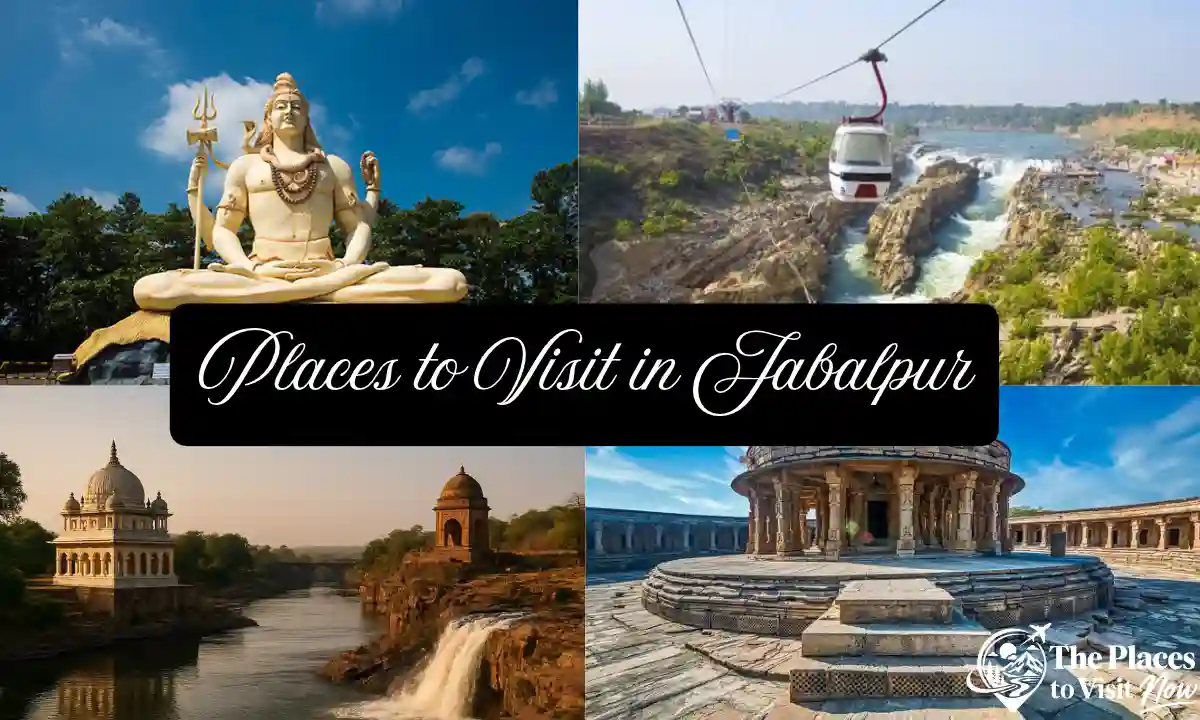
The two must-see spots in Jabalpur, which are just one kilometre apart and are in full glory at different times of the year, are never mentioned to anyone prior to booking.
The marble rocks at Bhedaghat, which are seen between white cliffs where the Narmada flows, are viewed from a rowing boat. Rowing is stopped for approximately four months each year, generally starting from mid-June to mid-October, when the water in the river is at its highest levels. The nearby Dhuandhar Falls reaches its splendor precisely during those four months when it roars through the gorge in a constant spray of water.
Thus, your answer to the question of when to visit will be determined completely by which of the two sites you want to see. The guide to places in Jabalpur that I prepared for you gives the rules stated clearly, and also mentions a temple overlooking the gorge that is never climbed by anyone, approximate prices in rupees, and the truth about the legendary moonlight boat ride.
Jabalpur at a Glance
| Detail | What to Know |
|---|---|
| Where | Central Madhya Pradesh, on the Narmada |
| The main sight | Bhedaghat, about 25 km from the city |
| The catch | Marble rocks boating is closed for roughly four months a year |
| Typical closure | Around mid-June to mid-October, dates set locally |
| The monsoon compensation | Dhuandhar Falls at full power, and the ropeway still runs |
| The overlooked sight | The 10th-century Chausath Yogini temple above the gorge |
| Best season overall | October to March |
| Ideal trip length | 1 to 2 days in the city, more if you add a park |
| The bigger role | Gateway to Kanha, Bandhavgarh and Pench |
| Park season | Core zones open roughly October to June |
The Four-Month Rule
This is the table that decides your trip. Build your dates from it rather than from a general best-time-to-visit line.
| When | Marble rocks boating | Dhuandhar Falls | Ropeway | Tiger reserves |
|---|---|---|---|---|
| October to March | Open, and at its best | Strong early, easing later | Running | Open |
| April to mid-June | Open, but very hot | Reduced flow | Running | Open, best sightings |
| Mid-June to mid-October | Usually suspended | At its most dramatic | Usually running | Core zones closed |
| Around Sharad Purnima | Open, with night boating | Post-monsoon, still strong | Running | Just reopening |
Two conclusions can be drawn here. If boat ride through the marble cliffs is your motive for visiting, then do not venture there in the monsoon season because on arrival, you would find the jetty closed. But if indeed you do visit in the monsoon season, you would definitely not have wasted your journey since the falls at this time are superb, the gorge is green and even the ropeway crossing the river operates most of the time.
This would provide you with the aerial view rather than viewing from the water level.”
The Night Boating Story, Accurately
Any description of Bhedaghat guarantees a moonlight ride between luminous cliffs. This is a very real thing, but it is much less frequent than the descriptions may lead you to believe.
Daytime boating stops in the early evening. Night boating is not something that happens regularly since the river between the cliffs is narrow and the boats are maneuvered in such a way that accidents do not happen. This is usually done during Sharad Purnima, the autumn full moon, as the festival of Narmada Mahotsav is conducted at Bhedaghat on that day with lights and music. It is said that moonlight on that particular day has some healing qualities, which is why people come.
Otherwise, availability of night boating can be inconsistent. If that is the reason for visiting the place, make sure that you visit on the Sharad Purnima. Otherwise, visit in the late afternoon as that will give you the best light for the marble cliffs.
Places to Visit in Jabalpur: The Shortlist
| Place | Distance | Time Needed | Best For |
|---|---|---|---|
| Bhedaghat marble rocks | About 25 km | 1 to 2 hours | The boat ride between the cliffs |
| Dhuandhar Falls | At Bhedaghat | 1 hour | Raw power, especially in monsoon |
| Dhuandhar ropeway | At the falls | 30 minutes | The view from above the gorge |
| Chausath Yogini Temple | At Bhedaghat | 1 hour | A 10th-century circular yogini shrine |
| Panchvati Ghat | At Bhedaghat | 30 minutes | Quiet riverfront below the temple |
| Madan Mahal Fort | In the city | 1 hour | A Gond-era hill fort with city views |
| Rani Durgavati Museum | In the city | 1 hour | Sculpture and Gond history |
| Balancing Rock | In the city | 20 minutes | A granite rock that survived an earthquake |
| Gwarighat | About 8 km | 1 hour | The evening Narmada aarti |
| Tilwara Ghat | About 7 km | 30 minutes | Where Gandhi’s ashes were immersed |
| Dumna Nature Reserve | About 15 km | 2 hours | Forest, a lake and easy walking |
| Bargi Dam | About 40 km | Half day | Boating and sunsets on the reservoir |
| Pisanhari ki Madiya | In the city | 45 minutes | A hilltop Jain temple complex |
| Kachnar City Shiva statue | In the city | 30 minutes | A very large seated Shiva figure |
Bhedaghat: The Marble Rocks
Approximately twenty-five kilometres away from the town, the Narmada cuts through some narrow reaches for about three kilometres between walls of cream, pink, and grey marble rock that rise about thirty metres. This can be observed while travelling in a rowing boat which is shared and the boatmen constantly give running commentary of names of rocks in terms of animals and shapes.
This running commentary forms an integral part of the experience but is not what the experience is all about. In reality, one observes a river carving a gorge out of soft stone rock over a great period of time.
- Go early in the morning or late afternoon. Midday flattens the marble and the glare off the water is harsh.
- Boats are shared and leave when full, which is usually quick in season.
- Wear a life jacket and do not stand up in the boat, however much the person in front of you wants a photograph.
- The shops at the top sell soapstone and marble carving, which is a genuine local craft here rather than an import.
Dhuandhar Falls and the Ropeway
Dhuan stands for smoke and Dhar for flow, and the name is perfectly fitting. At a short stretch below the marble gorge, the Narmada river flows into a narrow gorge where it drops about thirty metres to produce a permanent spray of water that is audible before you actually see it. During the rainy season, the falls become really thunderous, while in the dry season, they remain impressive and much closer to access.
The cable car across the gorge is the unsung hero. The cable car links the two banks of the gorge, giving you a panoramic view of the falls system that you will not be able to obtain from either side by walking. Additionally, it usually works while boating is not possible.
Chausath Yogini Temple: The Climb Nobody Makes
There is a temple dedicated to the sixty-four yoginis dating back to the tenth century which sits atop a hill overlooking the gorge at Bhedaghat, consisting of a circular structure with shrines surrounding a courtyard, and a later temple dedicated to Shiva inside.
This kind of temple is quite uncommon. There are very few examples of such temples in India, and circular yogini temples are especially unique examples of ancient Indian temple architecture. There are many original carvings left intact, along with a small museum containing yogini carvings.
- It is around a hundred and fifty steps from the road. This is the main reason why people miss it.
- Do try to visit it as early as possible because the view from up here overlooking the Narmada valley is the best view in the entire district.
- Some of the carvings are damaged. Appreciate the carving without the expectation of complete sets of carvings.
- If stairs are difficult for any member of your group, this is one site at Bhedaghat that you should miss.
The Gond Thread
Before the English and before the Marathas, this area formed the center of Gond rule from the Garha-Mandla dynasty, with Rani Durgavati as one of the most notable rulers, whose death came while fighting against the Mughals in 1564.
- Madan Mahal Fort: a modestly-sized hill fort of Gond origin located atop a granitic hillock with excellent views of the city below. An easy walk up, taking around an hour.
- Rani Durgavati Museum: the city’s museum, containing sculptures, inscriptions, and objects related to the history of this area, named after the queen.
- Balancing Rock: a huge granite rock precariously balanced atop another rock, surviving the earthquake that hit this area in 1997. Twenty minutes and free.
Together, these three sites give you a glimpse of Jabalpur completely unrelated to its riverfront, and that few tourists ever visit.
The Ghats
- Gwarighat: the main ghat on the riverside in the city, where there is an evening aarti conducted in the Narmada with lights floating on the river. No charge and completely local.
- Tilwara Ghat: less busy and of historical importance as the site where some of the ashes of Gandhi were immersed in the Narmada.
- Panchvati Ghat in Bhedaghat: under the yogini temple, and the most peaceful site in all of Bhedaghat.
One important thing to keep in mind for all of these. The Narmada is a functional river with strong current in some places. Bathing takes place at the ghats, but keep within the local ambit only.
Jabalpur as the Tiger Gateway
This is the role the city plays for most travellers, and it is worth being organised about.
| Park | Distance From Jabalpur | Known For | Season |
|---|---|---|---|
| Kanha | About 160 km | Open meadows, barasingha and strong tiger sightings | October to June |
| Bandhavgarh | About 190 km | The highest tiger density in India | October to June |
| Pench | About 200 km | Teak forest, quieter than the other two | October to June |
| Panna | About 270 km | Gorge landscape and a successful reintroduction | October to June |
Core zones close for the monsoon, roughly from July to September, and buffer zone safaris sometimes continue. Book permits online well in advance through the forest department portal, since they are capacity limited, and note that sighting odds improve through the hot months of April and May as water sources shrink.
Entry Fees and Costs
These are approximate figures for planning. Rates are revised periodically, so confirm at the counter before you go.
| Item | Approximate Cost (Rs) | Notes |
|---|---|---|
| Bhedaghat boat ride, shared | 150 to 300 per person | Closed roughly mid-June to mid-October |
| Private boat | 1,000 upwards | Worth it for photography |
| Dhuandhar ropeway | 100 to 200 return | Usually runs year round |
| Chausath Yogini Temple | Free or nominal | About 150 steps up |
| Yogini sculpture museum | Nominal | Near the temple |
| Rani Durgavati Museum | 20 to 50 | Closed on some days |
| Madan Mahal Fort | Free or nominal | Short climb |
| Dumna Nature Reserve | 50 to 100 | Toy train and boating extra |
| Bargi Dam boating | 200 to 600 | Shared and private options |
| Auto to Bhedaghat return | 600 to 1,000 | Agree waiting time in the fare |
| Full-day cab in the city | 1,800 to 2,800 | Covers Bhedaghat and the city sights |
| Jabalpur to Kanha taxi | 3,000 to 4,500 | About 160 km |
Best Time to Visit Jabalpur
| Months | Conditions | Verdict |
|---|---|---|
| October to February | Cool, dry, boating open, parks open | Best all-round window |
| Around Sharad Purnima | Night boating and the Narmada Mahotsav | The signature experience, very busy |
| March to mid-June | Hot, rising past 40 degrees | Best tiger sightings, hardest conditions |
| Mid-June to September | Monsoon, falls at full power, boating shut | Come for Dhuandhar, not the boat |
A 2-Day Plan
| Day | Morning | Afternoon and Evening |
|---|---|---|
| Day 1 | Bhedaghat early, boat ride then Dhuandhar and the ropeway | Chausath Yogini temple, then Gwarighat aarti at sunset |
| Day 2 | Madan Mahal Fort and Balancing Rock | Rani Durgavati Museum, then Bargi Dam or Dumna |
If you are heading on to Kanha or Bandhavgarh, do day one properly and leave the next morning. Jabalpur does not need a second day if a tiger reserve is waiting.
Practical Tips Most Jabalpur Guides Skip
- Check whether boating is functioning before setting off on your journey. The shut-down period is approximately four months long, but the dates are decided yearly.
- During the shutdown period, use the ropeway. It offers you a view of the gorge from above and generally runs even during the monsoon.
- Avoid planning a trip around moonlight boating unless it is Sharad Purnima. Moonlight boating does not happen often.
- Try to go to Bhedaghat as early as possible. It is a one-day tourist spot for the entire region and will be filled up in the afternoon.
- Take an auto-rickshaw or taxi to cover the entire trip in Bhedaghat, including waiting time, to avoid paying twice.
- Carry water bottles and a cap because the path from the boat landing point to the falls and the temple has very little cover.
- Get your permits for the tiger reserve in advance, if Jabalpur is going to be the first stop of your journey.
Trivia You Can Use to Sound Like a Regular
- Boating in the marble rocks is stopped for about four months per year during the spate period of Narmada River, normally from mid-June to mid-October.
- During this same period, Dhuandhar falls looks its best, thus creating a contrast in timing of two major attractions of Bhedaghat.
- Night boat rides in Bhedaghat happen only during Sharad Purnima, where it is said that the light from the moon can have healing effects, not every time when there is a full moon.
- Chausath Yogini Temple is one of the few remaining sixty-four yogini temples in India; it was built in the 10th century on a round plan.
- Jabalpur was the capital of Gond Kingdom of Garha-Mandla, whose ruler Rani Durgavati died in the fight against the Mughals in 1564.
- Balancing Rock in Jabalpur survived the earthquake that happened in this area in 1997, which is the very reason why Balancing Rock became a tourist attraction.
Final Take: Book the Boat or Book the Falls
Places worth visiting in Jabalpur boil down to a gorge and when you visit the same. Bhedaghat for the ride between the marble rocks, Dhuandhar for the waterfall, ropeway to catch a glimpse from above and the Chausath Yogini temple after climbing up all those hundred and fifty steps to see the place that most people avoid. For the history of Gonds and other artifacts from the city visit Madan Mahal and Rani Durgavati Museum while Gwarighat can offer you the river in the evening.
Your visit timings should depend upon the purpose for which you have planned this trip. October to March in case of the boat ride and the monsoon season for the waterfalls. Sharad Purnima is the season if you plan to see the illuminated water ride by moon light. Verify if the boating is available or not before making your trip and reach Bhedaghat early. Also book permits of Kanha and Bandhavgarh tiger reserve are well ahead of Jabalpur bookings.
Frequently Asked Questions
Is boating available at Bhedaghat all year?
No. Boating through the marble rocks ceases for a period of about four months during the floods in the Narmada River, normally mid-June to mid-October. These dates vary each year based on the conditions of the river and should be confirmed prior to traveling.
When is the best time to visit Dhuandhar Falls?
That time is also during the monsoon season when the Narmada River flows with full force and waterfalls are most spectacular. Boating, on the other hand, is not allowed at that time, so one cannot enjoy both at their best simultaneously.
Can you do night boating at Bhedaghat on any full moon?
Not always. Night trips are mostly related to Sharad Purnima, during which Narmada Mahotsav takes place and boat trips are organized. Otherwise, owing to the narrow passage between the rocks, the boat trip will have to be stopped by nightfall. You can plan your vacation accordingly.
What is the Chausath Yogini temple at Bhedaghat?
Temple of the sixty-four yoginis dating back to the tenth century built according to circular design located on a hill overlooking the gorge, having shrines surrounded by an open courtyard in the center. Not many temples of this kind are left in India. It is about one hundred fifty stairs to the top.
How many days do you need in Jabalpur?
One full day will be spent on Bhedaghat, Dhuandhar, ropeway, and yogini temple along with the evening at Gwarighat. The second day will include Madan Mahal Fort, museum and Bargi Dam. If you are heading to a tiger reserve after that, then one day will be sufficient for Jabalpur.
Is Jabalpur a good base for Kanha and Bandhavgarh?
Yes, but it is the standard one. Kanha National Park is about 160 kilometres from here, Bandhavgarh about 190 kilometres, and Pench around 200 kilometres. The nearest airport and rail-head is at Jabalpur. Core areas get closed during the monsoon, so make sure to book your permits in advance.
Note: Boating closure dates, ropeway operation, festival timings and park permits all change with river conditions and forest department decisions. Everything here is indicative. Confirm current status locally before travelling.
Also read more: Top 10 Places to Visit in Pondicherry: Ranked Honestly



Leave a Reply