
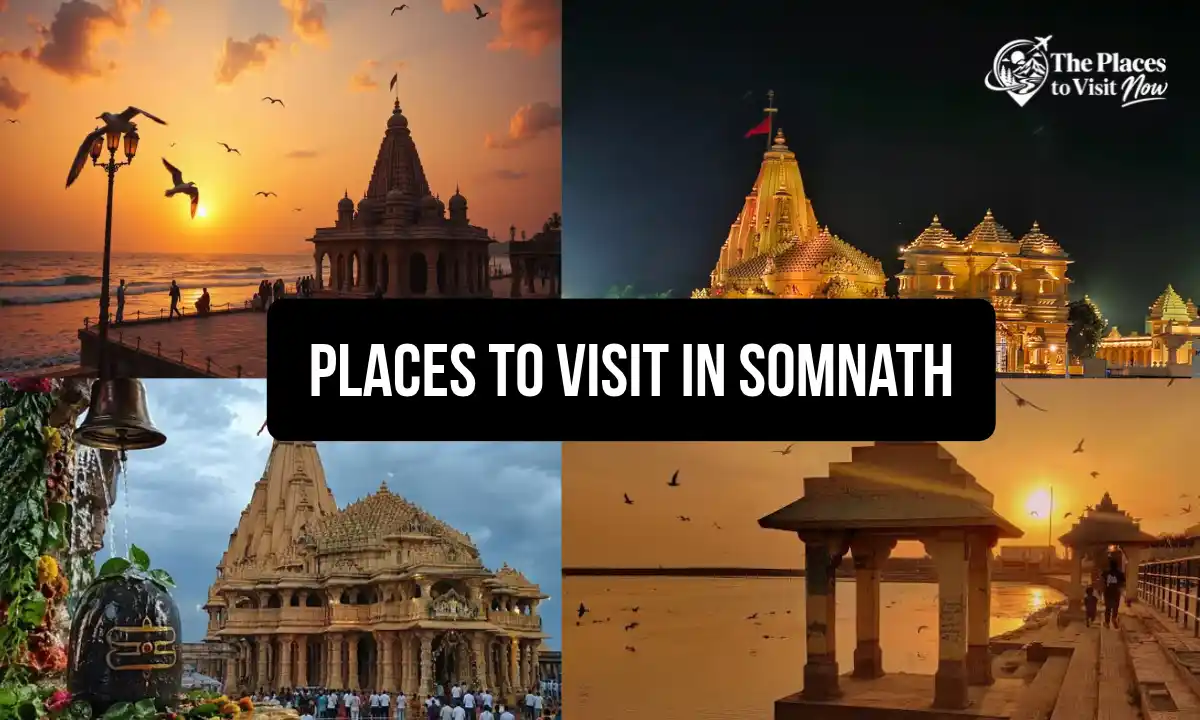
Here is the catch you don’t hear before reaching Somnath. Everyone does the exact same circuit: taxis from Veraval, darshan at the temple, a picture of the ocean from the wall, back in the taxi. Two hours in and it is all over. And they go away without visiting those two spots that actually give Somnath its unique charm among all the other temple towns in Gujarat.
Somnath is not just one place. It is three spots within about five kilometres of each other along the Saurashtra coastline, which come together to tell a single tale: The Jyotirlinga #1, the stone pillar pointing at the South Pole on the sea wall, and the peaceful riverbank on which the Mahabharata comes to an end. The temple gets the visitors. But the other two get the ones who have done their homework.
This guide is designed with that difference in mind. You get a list of places to visit in Somnath, but in the right order, with the entry points that surprise people, the costs mentioned in rupees, and a one day itinerary that doesn’t start at the temple.
The Three-Site Spine: Start Here
If you remember nothing else from this page, remember this table. These three places are the reason to come. Everything else in Somnath is a bonus.
| Site | What it is | Why people skip it |
|---|---|---|
| Somnath Jyotirlinga Temple | The main temple on the shore, first of the twelve Jyotirlingas, rebuilt in 1951 | Nobody skips this. This is the one everyone sees. |
| Baan Stambh | An arrow pillar on the sea wall behind the temple, with a Sanskrit inscription about the sea route south | It is small, unmarked in most guides, and sits behind the temple where the crowd is already walking away |
| Bhalka Tirth and Dehotsarg | Where Krishna was struck by the hunter Jara’s arrow, and where he was cremated, about 4 to 5 km away | It needs a separate short trip and the taxi driver will not suggest it unless you ask |
The practical takeaway: budget half a day, not two hours. If your driver has quoted you a two-hour Somnath halt, renegotiate before you set off.
1. Somnath Jyotirlinga Temple
The temple sits right on the beach, with nothing separating it from the Arabian Sea. That’s the entire experience – the sound of the water never ceases while you’re in the temple complex, and during the evening aarti, the sound of the ocean beneath the ringing of the bells is something that no photo can capture.
You’re seeing something relatively new. The temple was constructed and consecrated in May of 1951, and it was built in the Chaulukya or Maru-Gurjara style by the temple architects known as the Sompura family, who have designed Gujarati temples for centuries. It was decided that a new temple should be erected by Sardar Vallabhbhai Patel when he visited the ruins in November 1947, with the installation ceremony carried out by Dr Rajendra Prasad, the first President of India. Hence, while the material of the temple is new, the ground it stands on is very old indeed.
Details worth looking for
- The shikhara stands to a height of 155 feet with a kalash which reportedly weighs around ten tonnes.
- The flag post above it stands at a height of 37 feet, while the flag is replaced thrice in a day. At the right time if one stands in the complex one can actually see it being done, something that most visitors never realize.
- The Nandi in the sabha mandap, as well as the carved columns – look up, not ahead. It is on the ceilings where the Sompura artistry shines.
- Right walk up to the sea wall and take a look back at the temple from its southern end. That is the shot that people line up in front of but never get.
Entry and timings
The entry to the temple is free of charge. The premises remain open during the entire day till late evenings, with aarti ceremonies being held thrice a day; the last aarti ceremony witnesses maximum crowd. Also, there is a light and sound show in the evening within the premises of the temple. The timings vary according to the season and special days, so it is advised to check the timings on the arrival day.
2. The Gate Rules Nobody Warns You About
This part was created because it is the most common mistake that people make during their Somnath visit. The security here is tight, and the list of items that you can’t take into the temple is much bigger than you think.
| Not allowed inside | What to do about it |
|---|---|
| Mobile phones | Leave it at the hotel if you can. Free lockers are available at the entrance, but queues build up at aarti time |
| Cameras of any kind | Same again, locker or hotel. Photography inside the sanctum is not permitted |
| Smartwatches and fitness bands | This one catches almost everyone. Take it off before you join the queue |
| Tablets and laptops | Leave in the vehicle or hotel room |
| Leather items: belts, wallets, bags | Switch to a cloth or synthetic belt for the day |
Smart move: Walk straight to the temple barefoot, carrying only money in a fabric pouch, no other luggage, and your shoes. Leave your shoes at the entrance, walk inside, and bypass the entire process of putting your bag in a locker and queuing for a turn. Click away those photographs of the facade and the sea wall before entering security.
3. Baan Stambh: The Pillar Most Guides Walk Past
The arrow pillar may be seen at the rear of the temple where the arrow is attached to the stone pillar facing the sea. The name of the arrow pillar is Baan Stambh. The inscription of the stone pillar is in Sanskrit and the approximate translation means that there is no land from here to the South Pole.
It is indeed a very fascinating idea, which is why the arrow pillar is definitely worth five minutes at the very least.
Now, the honest version
You will find this pillar described online as ancient proof that Indians knew world geography thousands of years ago. Here is what can actually be said with confidence, and where the claim gets shaky.
| The claim | How it holds up |
|---|---|
| There is unobstructed ocean south of this point to Antarctica | Broadly fair. Look at a globe along Somnath’s longitude heading south and you pass through the open Indian Ocean with no major landmass in the way. The geography is not nonsense |
| The inscription is thousands of years old | Not well established. The age of the inscription and the pillar in its current form is not clearly documented, and the present temple complex dates to 1951 |
| It proves ancient navigational knowledge | This is interpretation layered on top of an undated inscription, not a conclusion the evidence forces |
What’s the point of this information? For one thing, the pillar is more fascinating if it’s told how it actually was rather than being sensationalized. The pillar in Gujarat that shows the route of the open sea to the south is a beautiful sight to see. It doesn’t have to be dated with an untrue date in order to be worth visiting.
4. Bhalka Tirth and Dehotsarg: Where the Mahabharata Ends
This is the one that all itineraries omit, and this is the one that lingers.
Around four kilometres from the temple lies Bhalka Tirth, a site where it is believed that Lord Krishna, resting under a tree, was mistaken for a deer and hit by an arrow fired by the hunter Jara. He supposedly then went to the bank of the Hiran river, and about five kilometres away, where the Triveni Sangam of three rivers meets the sea, is Dehotsarg, the place where it is believed he was cremated.
So if you have ever wondered where the Mahabharata ends, it ends right there, in a quiet spot on the coast of Gujarat with a lot fewer crowds than at the temple. It isn’t much of a spectacle. Just a shrine, a tree, a riverbank, water merging into the ocean. Spend a few minutes there and the whole weight of history will drop.
Note for those planning: Both of these places can be visited easily enough in a cab or auto, and should ideally be part of your visit before sunrise, when the light on the water is still soft and the temple queues aren’t building up yet.
The Full Shortlist of Places to Visit in Somnath
With the spine settled, here is everything else worth your time in and immediately around the town.
| Place | What it is | Time needed |
|---|---|---|
| Somnath Jyotirlinga Temple | The main temple on the shore; evening aarti is the high point | 1 to 2 hours |
| Baan Stambh | Arrow pillar on the sea wall behind the temple | 10 minutes |
| Bhalka Tirth | Where Krishna was struck by Jara’s arrow | 30 minutes |
| Dehotsarg and Triveni Sangam | Cremation site; confluence of three rivers meeting the sea | 30 to 45 minutes |
| Old Ahilyabai Temple | Earlier Somnath temple built under Ahilyabai Holkar; quieter, inside the complex area | 20 minutes |
| Prabhas Patan Museum | Carved fragments and sculpture recovered from earlier temple structures on the site | 30 to 45 minutes |
| Suraj Mandir | Old sun temple ruins close to the main complex | 20 minutes |
| Panch Pandav Gufa | Cave shrine linked by tradition to the Pandavas | 20 minutes |
| Gita Mandir | Temple with the verses of the Bhagavad Gita inscribed on its pillars | 20 minutes |
| Somnath Beach | The shore stretch beside the temple; good at sunset, not a swimming beach | 30 minutes |
| Veraval fishing harbour | Working harbour about 6 to 7 km away; boats, ice, nets, no tourists | 30 minutes |
| Light and sound show | Evening show on the temple grounds narrating the site’s history | 45 minutes |
Why even mention this to you? Because the pillar is actually more fascinating when described in reality than when it’s hyped up. There’s an indicator off the coast of Gujarat which marks the area where there is open water stretching out southwards. This is a beautiful thing to stand by. It doesn’t even require an unfounded date to make the journey worthwhile.
Day Trips: Somnath as a Base
Somnath works well as a pivot rather than a destination. Four genuinely good places sit within a comfortable drive.
| Destination | Approx distance | What it gives you |
|---|---|---|
| Gir National Park (Sasan Gir) | 45 to 65 km depending on gate | Asiatic lions; safari permits must be booked in advance and the park closes during monsoon |
| Diu | Around 90 km | Portuguese fort, churches, quiet beaches, a completely different feel from Saurashtra |
| Junagadh | Around 85 km | Uparkot fort, Girnar hill and its long stair climb, Ashokan rock edict |
| Porbandar | Around 130 km | Gandhi’s birthplace at Kirti Mandir, Sudama temple, coastal road |
Advice on combinations: The combination of Somnath, Gir, and Diu in three days is one of the best loops in Gujarat. Stay at Somnath for the temples and places from Mahabharata, Gir for seeing the lions, and stay at Diu for relaxing. Don’t plan to include Junagadh in the same combination unless you have four days.
Costs: What You Will Actually Spend
Rupee figures for a reality check. These are indicative and move with season and fuel prices, so confirm current rates before you commit.
| Item | Indicative cost | Note |
|---|---|---|
| Temple entry | Free | Lockers at the entrance are free as well |
| Light and sound show ticket | Around 50 to 100 per person | Buy at the venue; confirm show timing on the day |
| Prabhas Patan Museum | Small ticket, typically under 50 | Closed one day a week, so check before going |
| Auto within Somnath town | 50 to 150 per trip | Agree the fare before getting in |
| Taxi for the Bhalka and Dehotsarg loop | 400 to 800 | Covers both sites and brings you back; half a day |
| Veraval to Somnath transfer | 300 to 600 | Shared autos run cheaper |
| Budget room near the temple | 800 to 2,000 a night | Books out fast on festival days and weekends |
| Mid-range hotel | 2,500 to 5,000 a night | Sea-facing rooms carry a premium |
| Gujarati thali meal | 150 to 300 | Unlimited thalis near the temple are good value |
| Full-day taxi to Gir and back | 3,000 to 5,000 | Excludes safari permit and entry charges |
When to Visit
| Season | Months | What it is like |
|---|---|---|
| Winter | November to February | The best window. Pleasant days, cool evenings, sea breeze actually enjoyable. Peak crowds too |
| Summer | March to May | Hot and bright. Coastal air takes some edge off but midday is heavy. Do the temple early and late |
| Monsoon | June to September | Dramatic sea, green surroundings, fewer visitors. Gir safaris are generally closed through this stretch |
| Post-monsoon | October | Humid early, then it settles. Quietly one of the better months if you catch the second half |
Festival note: Mahashivratri is the biggest day at Somnath by a wide margin, and Shravan month brings heavy pilgrim traffic. Both are extraordinary to witness and difficult to move around in. If crowds are not your thing, aim for a weekday in December or January.
One Day in Somnath: An Hour-by-Hour Plan
This plan deliberately starts away from the temple, which is how you get the quiet sites to yourself and the temple at its best hour.
| Time | Where | Why then |
|---|---|---|
| 7:00 AM | Bhalka Tirth | Empty, soft light, and you get the story in the right order before you see the temple |
| 7:45 AM | Dehotsarg and Triveni Sangam | Morning on the riverbank where it meets the sea; barely anyone there |
| 8:45 AM | Breakfast in town | Fafda, jalebi, poha, tea. Fuel up properly |
| 9:45 AM | Prabhas Patan Museum | Carved fragments from the earlier temples, before the heat and before the temple crowd |
| 10:45 AM | Suraj Mandir and Old Ahilyabai Temple | Both short, both close, both overlooked |
| 11:30 AM | Somnath Temple and Baan Stambh | Photos of the exterior and the sea wall first, then leave the phone and go in |
| 1:30 PM | Gujarati thali lunch | Then rest through the worst of the afternoon |
| 4:30 PM | Veraval fishing harbour | A working harbour at the end of the day. No tourists, real Saurashtra |
| 6:00 PM | Somnath Beach and sea wall | Sunset from the south side looking back at the temple |
| 7:00 PM | Evening aarti | The sea and the bells together. This is the moment you came for |
| 8:15 PM | Light and sound show | Rounds off the history you have been walking through all day |
Practical Tips From People Who Have Done It
- Veraval is your rail head. It is around 6 to 7 km away from the temple, and this is where the majority of trains and long distance buses will drop you off. The nearest airports include Diu and Rajkot, while for long haul trips, the major airport is Ahmedabad.
- Wear slippers. You will take it off and put it back on more than once in a single day morning.
- Have money on hand. Smaller shops, autos, and shoe deposit counters around temples aren’t always card friendly.
- There is a prohibition law regarding alcohol in Gujarat. Plan accordingly, rather than finding out the hard way.
- Make sure to arrange for Gir safari permits in advance if you are combining the two. You can’t just hope for the best during the season.
- The sea in Somnath is for viewing only; don’t expect to swim. Currents are no joke here.
- If you have time for only one temple visit, then make it the evening aarti instead of midday darshan. Same line, but completely different experience.
- Find out the aarti time at your hotel. They vary depending on the day. An hour of your precious time is wasted by going for nothing.
Six Pieces of Somnath Trivia
- The flag on top of the shikhara is replaced thrice daily through a pole that is about 37 feet high.
- The weight of the kalash at the top of the temple is estimated to be about ten tonnes, while its height is about 155 feet above ground level.
- The decision to construct this temple was taken by Sardar Patel, after looking at the ruins in November 1947, and the consecration of the temple took place in May 1951, three years after the decision was made.
- The temple was constructed by the Sompura community of temple builders who belong to a hereditary architect lineage from Gujarat.
- The Somnath temple is considered the first among the twelve Jyotirlingas, and this itself makes it an important destination for pilgrims undertaking the journey of all twelve Jyotirlingas.
- Prabhas Patan was the ancient name of this town, which finds mention in Puranic scriptures before even the surviving monuments were built, making it significant to consider the museum artifacts over the stone structure.
Final Word
This is the temple you’ll photograph to take back home. The reason for visiting Somnath lies in the fact that inside a span of five kilometres you can see the Jyotirlinga temple, an inscription mentioning open seas stretching up to the South Pole, and the site on the river bank from where the Mahabharata ends. Three places in one day, and hardly anyone covers all of these.
Thus, allow yourself a half-day instead of just two hours. Arrive at Bhalka early enough in the morning, visit the museum and smaller shrines there, and leave the big temple for an evening aarti time when the sea waves can be heard through the ringing bells. This is the real Somnath worth visiting, and this is the Somnath that very few people have planned their visit to.
FAQ’s
How many days do I need in Somnath?
One whole day suffices for covering all aspects of the town including the temple, Baan Stambh, Bhalka Tirth, Dehotsarg, the museum, and the smaller temples, along with an evening aarti. If you intend to include Gir or Diu, you may need two to three days at Somnath.
Can I carry my phone inside Somnath temple?
No. Mobile phones, cameras, smart watches, tablets, and leather products are not allowed inside. Lockers are provided free of cost at the entrance; however, the line forms prior to the time of the aarti, and the simple way out is to keep the mobile phone at the hotel.
Is there an entry fee for Somnath temple?
Access to the temple is free of cost, while the lockers available near the entry point are also free of cost. The evening light and sound show as well as the Prabhas Patan Museum require separate small tickets.
What is the Baan Stambh and is it worth seeing?
It is an arrow pillar found on the sea wall beyond the temple, inscribed in Sanskrit saying that there is no land on the line going from that point towards the South Pole. The geographical description is quite accurate on a globe. There is no clear evidence for the repeated assertion that the inscription dates back to several thousand years ago. But at least the pillar is worth those ten minutes of your time.
How far is Bhalka Tirth from Somnath temple?
A few kilometers away from the temple, towards Veraval, Dehotsarg and Triveni Sangam are about 5 km away. The round trip costs about 400-800 rupees per taxi. It would be best to visit them early in the morning as they are less crowded than the temple and the water looks great with the sunlight.
What is the best time of year to visit Somnath?
November till February is the best time, when the weather is nice, with good days and the sea breeze is useful. From March to May is hot, and the monsoon season from June to September provides a very spectacular sea but also stops safaris in Gir. Mahashivratri and Shravan month see huge numbers of pilgrims.
Also read more: Best Places to Visit in India in June: The Month the Monsoon Walks Up the Map


Leave a Reply