
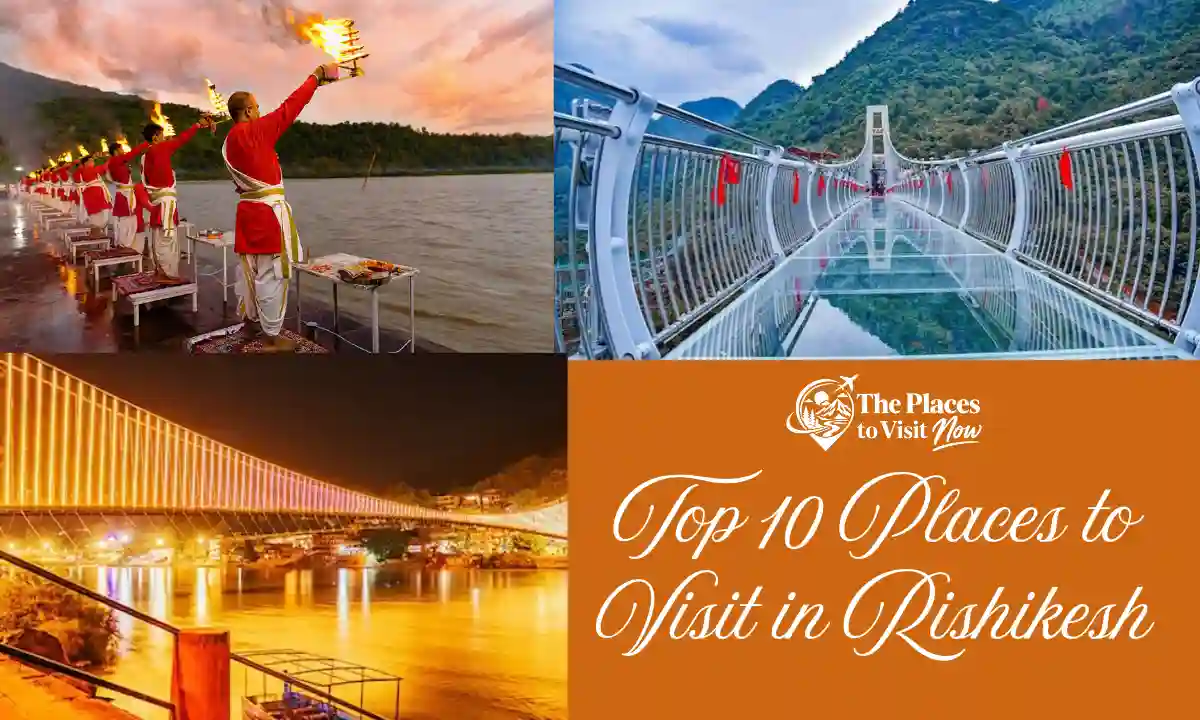
Lakshman Jhula is the most photogenic landmark of Rishikesh and it has remained shut since July 2019. The steel structure from 1929 has been shut for all pedestrian and vehicular traffic on account of failing load tests and it hasn’t reopened.
However, about 200 meters further upstream, a new bridge has been erected. Bajrang Setu is a glass-bottomed cable-stayed bridge and is touted as the first of its kind in India spanning the River Ganga. It has recently opened to visitors and so a lot of the top ten lists out there, featuring an old bridge that isn’t there anymore and missing out on a relatively recent bridge, is out of date.
Therefore, this list checks the status of the entries and doesn’t blindly follow the information on the internet. These are the top 10 attractions in Rishikesh, with their respective costs in rupees, the proper aarti to attend and the seasons when half of them become impossible to see due to climate reasons.
Rishikesh at a Glance
| Detail | What to Know |
|---|---|
| Where | Uttarakhand, where the Ganga leaves the hills for the plains |
| The bridge headline | Lakshman Jhula closed since 2019, Bajrang Setu now open |
| The new landmark | A glass-floor walkway roughly 70 feet above the river |
| Rafting season | Roughly September to June, shut during the monsoon |
| Best months | September to November and March to May |
| The town rule | No alcohol and no meat. It is a holy city |
| Beatles Ashram | Ticketed, Forest Department run, and it shuts by late afternoon |
| Two aartis | Parmarth Niketan and Triveni Ghat, and they are different |
| Ideal trip length | 2 to 3 days |
| From Delhi | About 240 km, five to six hours |
The Bridge Situation
Sort this out before you plan anything, because the bridges decide how you move between the two banks.
| Bridge | Built | Status | What to Do With It |
|---|---|---|---|
| Lakshman Jhula | 1929 | Closed to all crossing since July 2019 | Photograph it from the bank. You cannot walk it |
| Ram Jhula | 1986 | Open to pedestrians, free | The reliable crossing for Swarg Ashram and the Beatles Ashram |
| Janki Setu | Recent | Open to pedestrians | The quieter crossing between the two older bridges |
| Bajrang Setu | 2026 | Open, with a glass-floor centre section | The new landmark, roughly 200 m upstream of Lakshman Jhula |
One honest caveat. Bajrang Setu is new, and reports of its opening, timings and whether a ticket will eventually be charged have shifted through the year. Entry has been free since opening, with timings reported as roughly six in the morning to nine at night. Confirm locally before building an evening around it.
The Top 10, In Order
1. Bajrang Setu
This is the latest addition to Rishikesh and why this list is different from the lists that were compiled last year. A suspension cable bridge measuring approximately 132 meters and having a glass flooring in the middle, architectural towers in the temple style and lights that illuminate the bridge over the river at night.
To stand on the glass while the river Ganga flows almost 70 feet under you can be an eerie experience. Visit when it is dusky so that the lights are up and there are not many people around.
2. Ganga Aarti at Parmarth Niketan
The evening aarti by the ghat of Parmarth Niketan is the most atmospheric hour in all of Rishikesh. Lamps are lit in the river, there are chanters from the students of the ashram, and everything takes place in front of the seated form of Lord Shiva who is floating in the river.
It is completely free, and the timings depend on the season as well as the time of day being sunset. Come forty-five minutes prior for the step with the view, and take a seat instead of standing up front filming.
3. The Beatles Ashram
Chaurasi Kutia, where the Beatles were in residence in 1968 and where most of the songs for the White Album were written. This ashram was closed in the 1990s, taken over by the Forest Department and then opened up to the public, but it is now a fascinating and bizarre relic with meditation chambers, domed houses, and lecture halls decorated with murals and graffiti.
- The entry fee is around Rs 150 for Indian visitors, although higher for foreigners, as part of the Forest Department ticket.
- It closes in the later afternoon, usually at around four, so this is a morning or early afternoon destination and not one for sunset.
- Head up to the roof of the main house and hike along the trails behind the structures. This is where the ambiance is.
- Reach it via Ram Jhula or Bajrang Setu, from the Swarg Ashram side.
4. Ram Jhula and the Swarg Ashram walk
Ram Jhula has now become the functional centre of Rishikesh, since the closure of Lakshman Jhula. Walk across the bridge, and then stroll along the Swarg Ashram side, past the ashrams, book shops, brass shops, and cafe shops to the ghats.
It is free, always open, and the perfect place to discover the inner workings of the town. It is best to visit at dawn, before the tourists from Haridwar arrive.
5. White water rafting on the Ganga
Headline activity and season, more than the operator. Rafting happens between September to June, and is completely closed during monsoons when the river levels are very high and the operators are not allowed to run.
Common stretches include Brahmapuri, which is around nine kilometers for a short run, Shivpuri, which is around sixteen for a standard run, and Marine Drive, which is around twenty-six for a long day. Rapids in the Shivpuri stretch are known as Roller Coaster, Golf Course, and Return to Sender.
- Book a week ahead in peak season, since slots are capped.
- Helmets and life jackets are compulsory and non-swimmers can raft, but say so at the briefing.
- Riverside camping along the Ganga banks has been restricted for years, so check what a camping package actually involves and where it is located.
6. Triveni Ghat and its aarti
The main ghat in Rishikesh town itself, and a very different experience from Parmarth. This one is larger, busier and more local, with its own evening aarti and a morning ritual bathing crowd.
If Parmarth is the aarti people photograph, Triveni is the one people attend. Free, and worth doing on a second evening rather than instead.
7. Kunjapuri Devi Temple at sunrise
A small Shakti temple atop a hill can be reached via a short set of stairs from the road after about twenty-five kilometres. This place offers a splendid view that encompasses the Himalayan mountains on one side and Doon Valley and River Ganga on the other.
Start off for this place from the town by about four o’clock in the morning. This will offer the best views that can be obtained in the vicinity of Rishikesh on a cold winter morning.
8. Neelkanth Mahadev Temple
Around thirty kilometres away through the forest, a hilltop Shiva temple was built where, in tradition, Shiva drank the poison churned from the ocean, which turned his throat blue.
It is a serious pilgrimage site rather than a viewpoint, and it gets extremely busy during Shravan. The drive itself, climbing through the Rajaji forest, is half the reason to go.
9. Bungee jumping and the adventure cluster
India’s most famous fixed platform bungee jump site runs off a cantilever that stands at a height of eighty-three meters along with a giant swing and a flying fox.
The bungee is not inexpensive by Indian adventure standards, it is booked out on weekends and has certain weight limits. You need to book ahead of time online and do not plan any activity for later if you are trying this one.
10. Neer Garh Waterfall or Vashishta Gufa
Two entirely different options to finish your trip here. Neer Garh is a short walk uphill to waterfalls a few kilometers away from Lakshman Jhula that are best seen when it rains, while Vashishta Gufa is a meditation cave about twenty-two kilometers upstream from the Ganga.
Use the waterfalls if you have children with you. Use the cave if you traveled to Rishikesh for the serenity of it all.
The Ranking at a Glance
| Rank | Place | Cost (Rs) | Best Time of Day |
|---|---|---|---|
| 1 | Bajrang Setu | Free so far, confirm locally | Dusk |
| 2 | Ganga aarti, Parmarth Niketan | Free | Sunset, arrive early |
| 3 | Beatles Ashram | 150 Indian, more for foreign nationals | Morning, shuts by late afternoon |
| 4 | Ram Jhula and Swarg Ashram | Free | Early morning |
| 5 | Rafting | 600 to 2,000 per person | Morning, September to June |
| 6 | Triveni Ghat | Free | Evening or dawn |
| 7 | Kunjapuri Temple | Free, transport extra | Sunrise |
| 8 | Neelkanth Mahadev | Free, transport extra | Morning |
| 9 | Bungee at Mohanchatti | 3,500 to 4,500 | Booked slot |
| 10 | Neer Garh or Vashishta Gufa | Nominal or free | Late morning |
Which Aarti Should You Go To?
People arrive assuming there is one Ganga aarti in Rishikesh. There are two main ones and they suit different visitors.
| Parmarth Niketan | Triveni Ghat | |
|---|---|---|
| Character | Ashram-led, students chanting, highly ordered | Larger, louder, more local and less staged |
| Setting | Ghat steps below a large Shiva statue in the river | A broad town ghat with crowds on all sides |
| Crowd | Heavy with visitors and photographers | Heavy with pilgrims and residents |
| Go if | You want the famous version and good photographs | You want the version the town actually attends |
| Arrive | Forty-five minutes early for a seat | Twenty minutes early is usually enough |
Timings shift with sunset through the year, so ask at your guesthouse on the day rather than relying on a fixed hour.
What Rishikesh Does Not Have
Two simple truths that will surprise many first time tourists.
- No drinking. It is a religious town and the sale of alcohol is not allowed in Rishikesh. Avoid planning your evenings around it.
- No meat. Everything is strictly vegetarian all around the town and even in ashram kitchens without onion and garlic. Cafe culture is fantastic here, but again only vegetarian.
- Not much nightlife. Things shut down early and ghats become deserted after aarti because that’s the reason why you’re here, not a flaw.
- Monsoon shuts down a lot of things. Rafting ceases, paths become slippery and Ganga becomes dangerous.
Costs and Practicalities
These are approximate figures for planning. Rates change by season and operator, so confirm before booking.
| Item | Approximate Cost (Rs) | Notes |
|---|---|---|
| Bajrang Setu | Free since opening | A tariff may be introduced, confirm locally |
| Ram Jhula and Janki Setu | Free | Open to pedestrians |
| Beatles Ashram | 150 Indian, higher for foreign nationals | Forest Department ticket, shuts late afternoon |
| Rafting, 9 km Brahmapuri | 600 to 900 per person | Short run, good for first timers |
| Rafting, 16 km Shivpuri | 900 to 1,500 per person | The standard trip |
| Rafting, 26 km Marine Drive | 1,500 to 2,500 per person | A long day on the water |
| Bungee jump | 3,500 to 4,500 | Weight and health limits apply |
| Giant swing | 3,000 to 4,000 | At the same site |
| Kunjapuri sunrise taxi | 1,200 to 2,000 return | Leave around 4 AM |
| Neelkanth taxi | 1,200 to 2,000 return | Through the forest road |
| Yoga drop-in class | 300 to 800 | Most ashrams and studios allow one-off classes |
| Delhi to Rishikesh taxi | 4,000 to 6,000 | Five to six hours |
Best Time to Visit Rishikesh
| Months | Conditions | Verdict |
|---|---|---|
| September to November | Post-monsoon, clear, rafting reopens | Best window of the year |
| March to May | Warm, strong rafting flows, busy | Excellent, and the Yoga Festival falls in March |
| December to February | Cold, clear mountain views from Kunjapuri | Quiet and atmospheric, rafting reduced |
| July and August | Monsoon, rafting shut, river dangerous | Avoid unless you want a quiet ashram stay |
A 2-Day Plan
| Day | Morning | Afternoon and Evening |
|---|---|---|
| Day 1 | Ram Jhula crossing and the Swarg Ashram lanes | Beatles Ashram, then aarti at Parmarth Niketan |
| Day 2 | Rafting from Shivpuri | Bajrang Setu at dusk, then Triveni Ghat |
With a third day, start it at four in the morning for Kunjapuri sunrise, then take Neelkanth Mahadev on the way back. If adventure is your priority, swap that for the bungee and the giant swing.
Practical Tips Most Rishikesh Lists Skip
- Lakshman Jhula cannot be planned to be walked as it is shut since 2019. Ram Jhula, Janki Setu, or Bajrang Setu should be planned instead.
- Be sure about the timings and availability of tickets for Bajrang Setu as it is newly opened.
- Arrange Beatles Ashram trip before lunch time as it shuts in the evening and people come in at 5 PM to witness the sunset there.
- Make a rafting booking in advance in September, October, April, and May. Rafting bookings can be ignored in July and August.
- Carry money as Tapovan and smaller cafes around old Lakshman Jhula have erratic payment systems.
- Wear proper clothing to ghats and ashrams. Avoid being in the front row during aarti film recording over everyone’s head.
- Always carry a warm cloth despite seasons as evenings by the riverside get cold despite scorching days.
Trivia You Can Use to Sound Like a Regular
- Lakshman Jhula was built in 1929 and has carried pedestrians and motorcycles for ninety years until it closed down in July 2019 due to safety concerns.
- Bajrang Setu is approximately 200 meters upstream and carries a glass-floored middle portion, which allows one to see the Ganga about seventy feet down.
- The Beatles Ashram is situated in forest area, and it is managed by the Forest Department; this is why it has a ticket counter and closes in the evening.
- It was in Chaurasi Kutia that the Beatles stayed for a month in 1968 to compose most of the music for their album The White Album.
- Rishikesh is a dry city, where no alcohol nor any meat products are allowed, which explains the absence of nonvegetarian dishes in Rishikesh’s cafes.
- Rafting is suspended throughout the monsoon season not due to rains but due to excessively high water levels in the Ganga river.
Final Take: Check the Bridge, Then Build the Day
There are truly some changes in the top 10 tourist spots in Rishikesh within the recent few years, but most of the lists have yet to update. Lakshman Jhula has become an old picture, while Bajrang Setu with a glass floor is the new one. While Ram Jhula performs routine jobs. And aarti, Beatles Ashram, and the rafting are still what they always used to be.
Just two days can be enough if you schedule your time rather than relying on your map. Visit the Beatles Ashram early in the day since it closes early, aarti in the evening, rafting in the morning, Bajrang Setu at dusk as the lights turn on and Kunjapuri in the morning around 4 if you would like to see the mountains. Visiting there should be planned in September and November; take money and a sweater with you.
Frequently Asked Questions
Is Lakshman Jhula open in Rishikesh?
No. The 1929 suspension bridge was shut down for all pedestrians and vehicles because of structural instability in July 2019, and it has not been opened again since then. Photographs can be taken of it from the riverbank. You can cross using Ram Jhula, Janki Setu, or Bajrang Setu.
What is Bajrang Setu?
A cable-stayed bridge across the Ganga about 200 meters upstream from Lakshman Jhula with a glass floor walkway at its center has been constructed in India. It has now become operational for the public and entry is free until now and timing is stated to be around 6 AM to 9 PM.
Which Ganga aarti is better in Rishikesh?
For the elaborate and organized form conducted by ashram students, go to Parmarth Niketan. For the slightly smaller and local version attended by the residents of the town, go to Triveni Ghat. If you are able to make it for both, arrive at Parmarth forty-five minutes before time.
When is rafting available in Rishikesh?
September through June, and the ideal period is September to November and March to May. Rafting becomes impossible during monsoons, which are July and August months, due to the high water level of the Ganga. Reserve your raft about a week prior in the peak season.
Is alcohol available in Rishikesh?
No. Rishikesh is a holy city where alcohol is prohibited, and food across the town is vegetarian. The cafe scene is excellent and entirely meat-free, and most places close early in the evening.
How many days are enough for Rishikesh?
Two days for the ghats, Beatles Ashram, rafting and bridges. The third day will give you an option to have a four in the morning drive to catch sunrise at Kunjapuri and Neelkanth Mahadev en route or to do bungee and giant swing at Mohanchatti.
Note: Bridge status, opening timings and any entry charges in Rishikesh have changed repeatedly in recent years and remain in flux. Rafting availability depends on the season and operator permissions. Everything here is indicative. Confirm locally before travelling.
Also read more: Places to Visit in Warangal: Everything Here Was Built by One Dynasty
Leave a Reply