
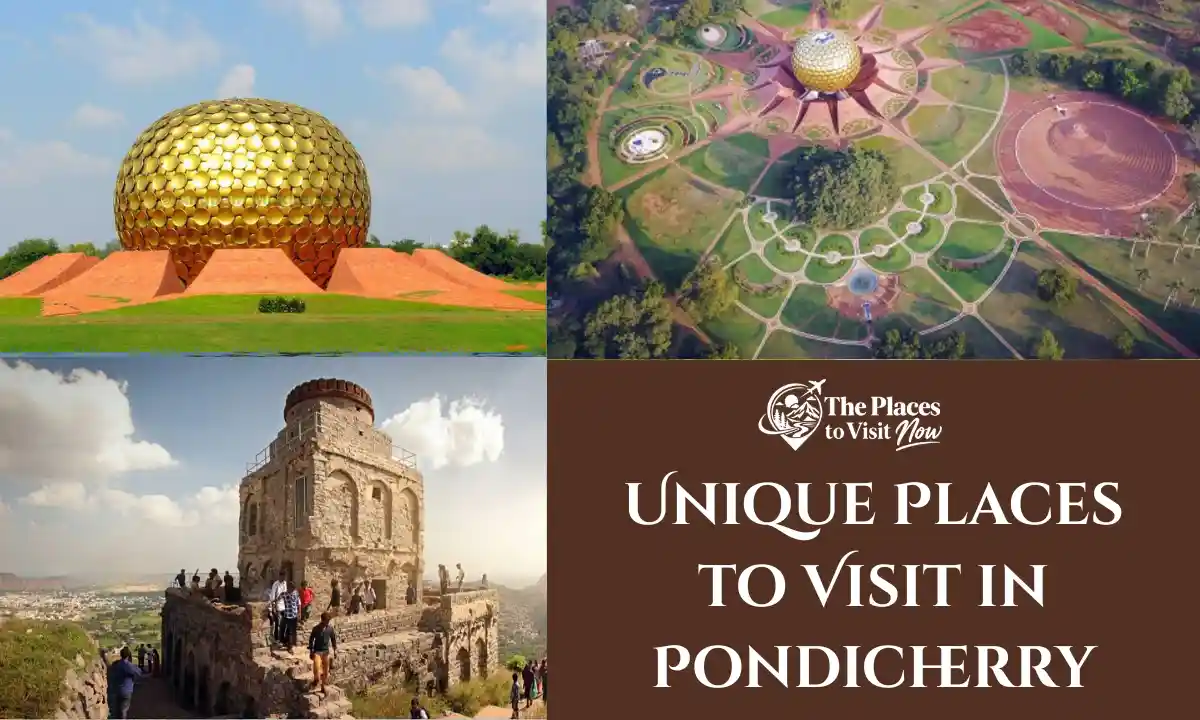
It is possible to see an afternoon’s worth of Pondicherry, in about forty photos, with yellow walls, a door draped in bougainvillea, a café with signs in French, a walk along the coast in the evening light, and Auroville’s golden dome in the distance. It is beautiful, and it is real. And it is everything that everyone sees.
What is remarkable about this little town is that it just happens to have on its soil the most significant archaeological site in all of India, a collection of palm leaf manuscripts among the largest in the world, an experimental township that builds domes from compacted earth, and a legal geography divided into four pieces spread across three states.
None of that is listed on the regular itinerary. This guide is for those unique attractions in Pondicherry that make it worthwhile to stay for a second and even third day, their approximate admission fee in rupees, honest thoughts on the beaches, and worthwhile day trips.
Pondicherry at a Glance
| Detail | What to Know |
|---|---|
| Official name | Puducherry, a union territory, not part of Tamil Nadu |
| Colonial history | French, not British, until 1954 |
| Best season | November to March, avoiding heavy northeast monsoon days |
| Ideal trip length | 3 days for the offbeat version, 2 for the standard one |
| Getting around | Rented two-wheeler or bicycle, the town is small and flat |
| Most overlooked site | Arikamedu, a 2,000-year-old Indo-Roman port |
| Beach reality | The main seafront has no sand and no swimming |
| Matrimandir | Inner chamber needs advance booking, not a walk-in |
| Languages | Tamil mainly, with French still taught and spoken |
| Common surprise | Puducherry has four districts across three states |
The Fact That Reframes the Whole Place
Puducherry is not one town. It is a union territory made of four separate enclaves that do not touch each other, scattered along two coasts of India and surrounded by three different states.
| District | Located Inside | Local Language | Distance From Puducherry |
|---|---|---|---|
| Puducherry | Tamil Nadu | Tamil | The main town itself |
| Karaikal | Tamil Nadu | Tamil | About 130 km south |
| Yanam | Andhra Pradesh | Telugu | About 800 km north-east |
| Mahe | Kerala | Malayalam | About 650 km west, on the Arabian Sea |
This is the remnant of French India, which is managed administratively well into its existence even after the transfer of territory way back in 1954. This is the same union territory that comprises both a coastal city that speaks Malayalam along the Arabian Sea and a deltaic city that speaks Telugu along the Godavari river delta. If you have time to spare, Karaikal makes for an interesting extension to your itinerary.
Arikamedu: The Roman Port Almost Nobody Visits
It is the most underrated historical site in this region, and it is situated at around seven kilometres from the cafe area, close to Ariyankuppam.
Arikamedu is believed to be the ancient port known as Poduke in Greco-Roman texts. Archaeological excavations, especially those led by the archaeologist Mortimer Wheeler, have found the remains of Roman amphorae, pottery and beads and have confirmed the existence of an active trading settlement dating back from the 1st century BCE to the 2nd century CE. It was more than a symbolic connection as there were goods, craftsmen and people who moved here during the time when the Roman Empire was flourishing.
All that can be seen on-site is very little. The brick foundations, walls covered with moss and plants, and the ruins of a Jesuit missionary building, which was built later next to the Ariyankuppam river. There is no entrance ticket, no big sign, and rarely other people visiting this place. You should come there in the morning hours, wear good shoes as the grounds are uneven and combine it with the Pondicherry Museum.
Unique Places to Visit in Pondicherry: The Shortlist
| Place | What Makes It Unique | Time Needed |
|---|---|---|
| Arikamedu | Indo-Roman trading port ruins | 1 to 2 hours |
| Pondicherry Museum | Roman artefacts plus French colonial rooms | 1 hour |
| French Institute of Pondicherry | Vast palm-leaf manuscript collection | 1 hour |
| Sadhana Forest | Volunteer-run reforestation community | Half day |
| Auroville Earth Institute | Compressed earth architecture research | 1 to 2 hours |
| Svaram sound garden | Handmade musical instruments you can play | 1 hour |
| Ousteri Lake | Wetland with migratory flamingos and waders | Half morning |
| Notre Dame des Anges | Greco-Roman church with a French oil painting | 30 minutes |
| Manakula Vinayagar Temple | Dozens of gold-plated forms of Ganesha | 30 minutes |
| Cluny Embroidery Centre | Working embroidery unit in a convent building | 45 minutes |
| Handmade paper unit | Ashram-run paper making, open to visitors | 45 minutes |
| Veerampattinam | Fishing village with a famous car festival | 1 hour |
| Bharathiar Memorial Museum | Home of the Tamil poet Subramania Bharati | 30 minutes |
| Pichavaram | Vast mangrove forest, day trip | Full day |
| Gingee Fort | Hill fortress called the Troy of the East | Full day |
Reading the Streets: White Town Versus Tamil Town
Most visitors capture pictures of the yellow walls without realizing that they stand on one side of an intentional historical division.
The old town had been divided by a canal called the Grand Canal. Ville Blanche or the French Quarter stood on the seaward side while Ville Noire or the Tamil Quarter lay on the other side. Two different architectural languages evolved on either side, and they still exist today.
- Houses of the French Quarter: high walls of the compound, large gateways for entrance, deep verandas with their backs facing the streets, color scheme of ochre and white, and street facades that don’t reveal anything.
- Houses of the Tamil Quarter: a raised platform called the thinnai where the occupants could sit and converse with the streets, carved wooden columns, open internal courtyards towards the sky, and much more colors.
Take a walk along Rue Dumas and Rue Suffren for the French Quarter houses and then move into the lanes of Vysial Street for the Tamil Quarter houses. This makes the best free hour in town for anyone who wishes to understand the place through a photo walk.
Auroville Beyond the Matrimandir:
To begin with the hard reality. It is not something you just go into. You get a pass from the Visitors Center to go to the outer viewing point, while entry to the inner structure needs booking beforehand on certain mornings. Auroville takes Tuesday as their day off. Be guided by this fact rather than going there hoping for the best.
However, there is another fact about it being an insignificant structure compared to what Auroville really is about.
Sadhana Forest
A volunteer group who has worked for the past twenty years to reforest the barren land and conserve water. They conduct free guided tours and a common lunch at fixed days, and everything is done in an off-the-grid manner. It is the most unique half-day experience in the area.
Auroville Earth Institute
This is a research center that works on buildings that use compressed stabilized earth blocks, vaults, and domes. This is a unique place to see what the experiments look like in reality. If you have an interest in architecture and sustainable building, this is an unusual opportunity for you.
Svaram sound garden
Workshop for building handmade musical instruments and sound healing instruments; an outside garden with large sculptures that you can play on. Unique and fun for kids.
The Solar Kitchen and Auroville Bakery
The Solar Kitchen prepares community meals using a big solar concentrator dish located on its rooftop. The bakery adjacent to it is where most of Auroville eats from. They are both accessible to visitors but not listed on any usual guides.
Auroville Botanical Gardens
The conservation project involved native Tamil Nadu plants instead of ornamental ones, with a seed bank and a little maze. Calm, inexpensive, and shady.
Ousteri Lake: The Birding Side of Pondicherry
Ousteri is a huge wetlands complex which has been recognized to be among the more important bird sanctuaries in the area. The migrating birds include flamingos, avocets and godwits, while resident birds consist of jacanas, coots and raptors.
The place needs to be visited early in the morning with binoculars. It should not be treated as an established park as the facilities are limited and maintenance is erratic. The season for bird-watching is November to February.
Small Museums and Working Places:
- Pondicherry Museum: Colonial French furniture, a ceremonial vehicle, sculpture, and Roman artifacts found in Arikamedu. Nominal admission fee, and closed on Mondays.
- French Institute of Pondicherry: One of the most comprehensive collections of palm leaf manuscripts, along with serious studies on ecology and Indology. This place is not open to public, but for researchers only, so you will need to call ahead.
- Bharathiar Memorial Museum: The home of the Tamil poet Subramania Bharati while he was in exile here. Entrance is free or nominal, and very inspiring.
- Cluny Embroidery Center: An old convent used by local ladies who produce hand embroidered work. They are happy to show how they do it, and you can purchase there.
- Sri Aurobindo Ashram handmade paper unit: A factory producing handmade paper from cotton rags, and open to visitors. It’s worth spending a satisfying half an hour here.
- Sri Aurobindo Ashram main building: Free entrance, silence and completely different atmosphere compared to the streets outside. No photography allowed.
Churches and Temples With Something Unusual:
- Church of Notre Dame des Anges: Constructed in Greco-Roman style, cream and pink colored, with an oil painting supposedly donated by Napoleon III. It is the most beautiful and least frequented of all the churches in the town.
- Temple of Manakula Vinayagar: Devoted to Ganesha, with gilded panels showing various avatars of the god throughout the temple ceiling and walls.
- Basilica of the Sacred Heart of Jesus: Gothic style with stained glass panels showing scenes from the life of Jesus Christ. More beautiful inside than outside.
- Veerampattinam Village: This is a coastal fishing village that has a tradition of car festival, where a massive temple cart is taken around the village. Worth visiting during their car festival time.
Day Trips Worth the Drive:
- Pichavaram: approximately 85 kilometres away from the north, the largest mangrove forest in the world, accessible by row boat via channels where the canopy shuts you in. Take the row boat, not the motorboat, because only the former can access those channels.
- Gingee Fort: approximately 70 kilometres inland, an extensive fort complex covering three hillocks and known as the Troy of the East. There is a strenuous climb to Rajagiri, which needs to be done early in the morning.
- Thiruvakkarai Fossil Wood Park: approximately 40 kilometres away, with tree trunks fossilised for almost 20 million years found lying in an open field area. Hardly known and truly bizarre.
- Chidambaram and Mahabalipuram: temple architecture in two distinct styles, each easily reachable for a day trip.
The Beach Truth Nobody Tells You
That is usually where first-time visitors do it wrong.
Promenade Beach, known locally as Rock Beach, doesn’t have any sand. It is a rocky barrier built to prevent erosion. Swimming is impossible there. It is an excellent place to have a walk at night, not the beach in itself. It is closed for cars during evening hours.
- Paradise Beach can be accessed by boat from Chunnambar, and you will need a ticket for both. There may be long lines there on the weekend or holidays. Visit Paradise Beach only in weekdays, preferably early in the morning.
- Serenity Beach is a surfing beach; there are two surf schools here conducting classes. It does have sand; however, the currents differ and it is not the right place for casual swimming.
- Auro Beach is less crowded and situated near Auroville. The same comment about currents applies.
To sum up, Pondicherry is a coastal city rather than a beach destination. Come for the streets, the culture, and the cuisine; and enjoy beaches on your way.
Entry Fees and Ticket Prices:
These are approximate figures for planning. Rates are revised periodically, so confirm at the counter or with the venue before you visit.
| Place or Activity | Approximate Cost (Rs) | Notes |
|---|---|---|
| Arikamedu | Free or nominal | No formal ticket counter, uneven ground |
| Pondicherry Museum | Nominal, around 20 to 50 | Closed Mondays |
| Sri Aurobindo Ashram | Free | Silence observed, no photography |
| Matrimandir viewing point | Free pass from Visitors Centre | Inner chamber needs advance booking |
| Auroville Botanical Gardens | 50 to 100 | Native species focus |
| Sadhana Forest tour | Free, donations welcome | Set days only, check schedule |
| Svaram sound garden | Nominal | Instruments can be played |
| Ousteri Lake | Nominal | Early morning only |
| Botanical Garden, town | Nominal | Toy train charged separately |
| Paradise Beach boat | 300 to 500 return | Plus entry, long weekend queues |
| Surf lesson, Serenity Beach | 1,500 to 2,500 | Board and instructor included |
| Scooter rental per day | 350 to 600 | Carry a valid licence and helmet |
| Bicycle rental per day | 100 to 250 | The town is flat and small |
| Pichavaram rowboat | 1,000 to 1,500 per boat | Rowboat beats the motorboat |
| Gingee Fort entry | 25 to 40 Indian | Steep climb, start early |
Best Time to Visit Pondicherry:
| Months | Conditions | Verdict |
|---|---|---|
| December to February | Cool, dry, best birding at Ousteri | Ideal window |
| March to May | Hot and humid, sea breeze helps | Early mornings only |
| June to September | Warm, some rain, fewer visitors | Workable and cheap |
| October to November | Northeast monsoon, heaviest rain | Wettest period, cyclone risk |
It should be noted that the primary source of rainfall in this region is the northeast monsoon; thus, for this region, October and November are rainy months while other parts of India are dry at this time.
A 3-Day Offbeat Plan:
| Day | Morning | Afternoon and Evening |
|---|---|---|
| Day 1 | Arikamedu at first light, then the museum | French and Tamil quarter walk, promenade at sunset |
| Day 2 | Auroville: Earth Institute, Svaram, Sadhana Forest | Botanical gardens, Auro Beach sunset |
| Day 3 | Ousteri Lake birding at dawn | Cluny centre, paper unit, Notre Dame des Anges |
If you have a fourth day, use it entirely for Pichavaram or Gingee Fort, since both need an early start and a full day.
Practical Tips Most Pondicherry Guides Skip:
- Make sure to pre-book your time in the Matrimandir inner chamber and know about the day that Auroville closes during the week.
- Take a cycle instead of a scooter if you are staying in the old town. It is easy, compact and parking in White Town is quite tough.
- Reach Arikamedu early. There is no shade, no facilities and no place to escape the sun after it gets hot during the day.
- Carry cash as several of the smaller museums, the ashram units and village stops do not have any facility to accept cards.
- There is no liquor duty in this area as a union territory, which is the reason why there are many people here during the weekend. Make your bookings for weekend stays.
- Dress decently in the ashram and temples and remember that there are restrictions on photography in several of them.
- Keep in mind the northeast monsoon as October and November can ruin a whole trip to this part of the coast.
Trivia You Can Use to Sound Like a Regular:
- Puducherry comprises four disconnected territories spread across three states, one speaking Malayalam on the coast of the Arabian Sea and one speaking Telugu in the Godavari delta.
- Arikamedu is recorded by Greco-Roman sources as Poduke, where excavations have unearthed fragments of Roman amphorae along with local potteries and beads.
- The old town was bisected by a waterway known as the Grand Canal, where the French sector was separated from the Tamil sector and developed entirely distinct house types.
- Pondicherry became Indian in 1954, seven years after the rest of the country received its independence, owing to its being French, and not British, territory.
- The Promenade is no beach whatsoever; rather, it is a man-made rock barrier designed to prevent the coastline from erosion, which is why there is no sand on the shoreline.
- Auroville was founded in 1968 with soil gathered from more than 120 countries, kept in an urn still present next to the Matrimandir.
Final Take: Give the Town a Third Day
The special sites in Pondicherry are not difficult to discover but rarely visited. Arikamedu is seven kilometers away from the coffee shops and mostly deserted in the mornings. Tamil area is located two minutes away from the French quarter, but attracts little of the tourists’ attention. Auroville has its earth architecture institute, reforestation community and sound garden and most people see the dome there from the observation point.
It requires only three days. Spent the first day in the town and Arikamedu, the second in Auroville for real, not as a part of a quick picture-taking trip, and the third day – in Ousteri in the morning and in the small local workshops further on. Reserve the Matrimandir in advance, rent a bike and try to avoid October and November if possible.
Frequently Asked Questions
What is the most unique place to visit in Pondicherry?
Arikamedu, an Indo-Roman port that was excavated near Ariyankuppam and identified as the port of Poduke. The site yielded Roman amphorae sherds and pottery and beads from a site used during the period around 1st century BC to 2nd century AD. It is located around seven kilometers away from the town and is always deserted.
Do you need to book the Matrimandir in advance?
Yes, for the inner chamber. You get a free entry ticket to the outside viewing place from the Auroville Visitor’s Centre, but to visit the inner chamber, you have to choose some specific mornings when it is open. But remember, there is one closed day per week in Auroville.
Can you swim at Pondicherry beaches?
Not in the primary coastline area. The Promenade beach is an artificial rock barrier in the water, without any sand or bathing facilities. The Serenity Beach and Auro Beach have sandy shores but fluctuating tides, while the Paradise Beach can be reached only by boats from Chunnambar.
How many days are enough for Pondicherry?
Two days suffice for the usual itinerary. Three days suffice for the quirky one, with one day for the town and Arikamedu, another for Auroville, and one more for Ousteri Lake and the small workplaces. The fourth day could be for Pichavaram or Gingee Fort.
Is Pondicherry part of Tamil Nadu?
Puducherry is not part of Tamil Nadu. It is a distinct Union Territory comprising four non-contiguous districts. Puducherry and Karaikal are situated within Tamil Nadu, Yanam within Andhra Pradesh, and Mahe within Kerala, all of which were erstwhile French territories handed over in 1954.
What is the best time to visit Pondicherry?
From December through February, when the climate is cool and dry, and the waters of Ousteri Lake are perfect for migratory birds. From October through November comes the northeast monsoon season that brings heavy rainfall, and also the cyclone season from the Bay of Bengal.
Note: All fees, timings, access rules and booking requirements listed here are approximate and revised periodically. Confirm current details with the venue before your visit.
Also read about: Places to Visit in Alleppey in 1 Day: Get the Boat Decision Right First


Leave a Reply