
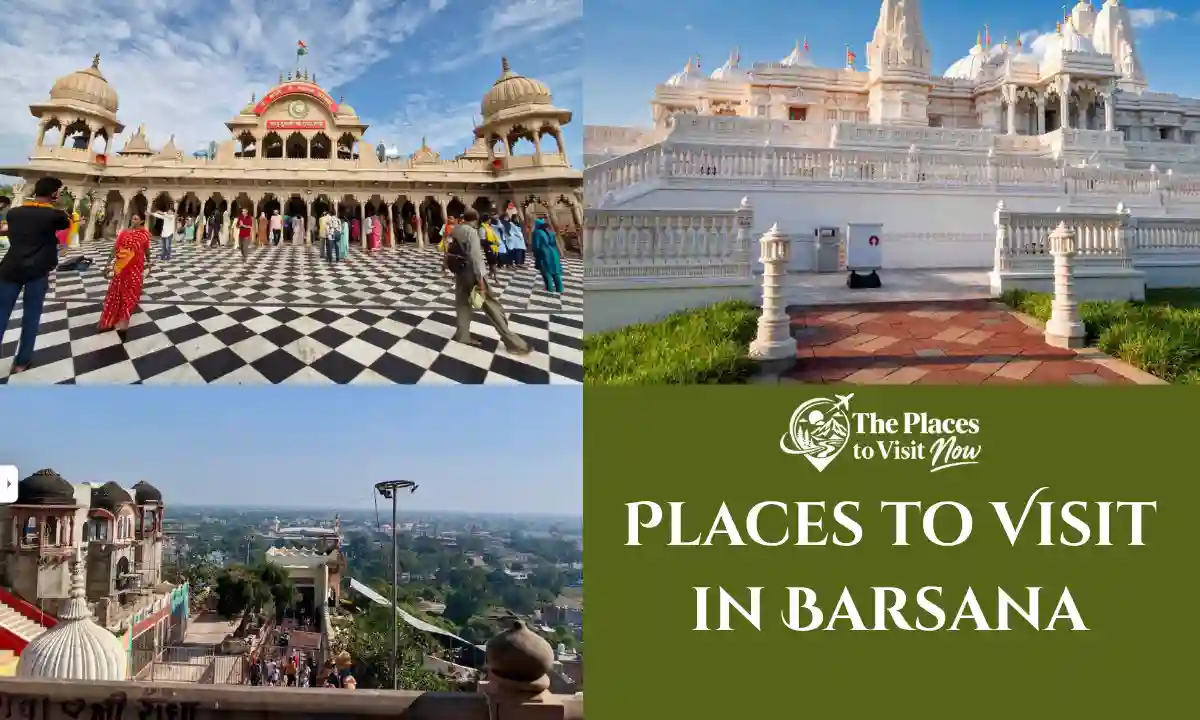
Barsana has two things to surprise tourists with, but these can be easily avoided.
The first one is the date. While Barsana’s Holi with its sticks and shields seen in every picture of Indian Holi takes place a week before the holiday itself, people come on the Holi day and discover that the celebration has already finished.
Another one is the location. Barsana is not a flat village with temples on its streets. The village is situated on four hills and all the main places are situated on these hills. The central temple is more than 200 stairs up there.
This guide will tell you about places in Barsana with both these issues resolved. There is a schedule of the Holi events with the Holi date for comparison to never go out of date, a map with the description of which sites require climbing stairs and their alternatives and approximate cost in rupees.
Barsana at a Glance
| Detail | What to Know |
|---|---|
| Where | Mathura district, Uttar Pradesh, in the western Braj region |
| Why it matters | Traditionally held to be the village of Radha |
| Distance from Mathura | About 45 km, roughly an hour and a quarter |
| Distance from Vrindavan | About 50 km |
| Distance from Nandgaon | About 8 to 10 km, and they are visited as a pair |
| Main temple | Shriji, also called Ladli Ji, on Bhanugarh hill |
| Entry to the temple | Free |
| The climb | Roughly 200 to 225 steps, with a ropeway and palki as alternatives |
| Biggest festivals | Lathmar Holi and Radhashtami |
| Ideal visit length | Half a day, or a full day with Nandgaon |
The Village Where Radha Comes First
Radha appears with Krishna almost everywhere else in India. Not in Barsana. The Shriji temple on Bhanugarh hill is one of the rare places where Radha herself is the main god and has her own temple here, and the town itself is built around the temple.
The local version of Radha is called Ladli Ji, and she is the much-loved daughter of the village. The typical greeting in Braj will be Radhe Radhe and not Namaste. And even the four hills that surround the town have an explanation in local traditions: these hills represent four heads of Brahma, and hence Bhanugarh is called Brahma parvat.
The way the space is ordered makes us rethink the place. Barsana is not the Krishna site where Radha has a temple. Barsana is Radha’s town, and Krishna is a guest from the neighboring village.
The Holi Sequence: Barsana’s Festival Is Not on Holi
This is the one most useful fact about this page. The Holi festival in Braj does not occur over one day, but spans approximately two weeks, moving from village to village, with the day that is most well-known in Barsana coming early on in the schedule.
The days are calculated based on the lunar calendar and thus change each year, and the list provided below is calculated relative to the date of Holi, rather than according to the calendar. This order is the same each year. Check the exact dates locally, as they will be published near the time of year.
| When | Where | What Happens |
|---|---|---|
| About 40 days before Holi | Across Braj | Festivities begin around Basant Panchami and build slowly |
| About 8 days before Holi | Barsana | Laddu Holi, when sweets are showered on the crowd from the temple |
| About 7 days before Holi | Barsana | Lathmar Holi, the famous one with sticks and shields |
| About 6 days before Holi | Nandgaon | Lathmar Holi in reverse, as Barsana’s men visit Nandgaon |
| About 5 days before Holi | Vrindavan | Phoolon wali Holi at Banke Bihari, played with flower petals |
| The night before Holi | Everywhere | Holika Dahan bonfires |
| Holi itself | Mathura and Vrindavan | The main day of colour across the region |
| The day after Holi | Baldeo, near Mathura | Huranga, another stick and cloth contest |
| About 5 days after Holi | Across Braj | Rang Panchami, the closing day of the season |
What it means practically. If one wishes to experience Lathmar Holi at Barsana, then it is advisable to visit around a week prior to the date of Holi. In case one wants to visit Barsana during the Holi period, one will find colour but the stick game would have been played before that.
Places to Visit in Barsana: The Shortlist
| Place | What It Is | Climb Involved | Time Needed |
|---|---|---|---|
| Shriji or Ladli Ji Temple | The main Radha temple on Bhanugarh hill | Around 200 to 225 steps | 1 to 2 hours |
| Maan Mandir | Where Radha is said to have sat in loving anger | Hilltop, moderate climb | 45 minutes |
| Mor Kutir | Where Krishna danced as a peacock for Radha | Short climb | 30 minutes |
| Sankari Khor | A narrow gorge between two of the hills | Uneven ground, no steps | 30 minutes |
| Peeli Pokhar | A pond linked to Radha’s turmeric ceremony | Flat, easy access | 20 minutes |
| Kirti Mandir | A large modern temple to Radha’s mother Kirti | Flat, easy access | 45 minutes |
| Gahvar Van | The forest grove associated with Radha’s childhood | Flat walk | 1 hour |
| Dan Garh | Where Krishna is said to have levied a toll on the gopis | Hilltop climb | 30 minutes |
| Vilas Garh | A quieter hill shrine on the Barsana circuit | Hilltop climb | 30 minutes |
| Jaipur Temple | A well-built temple in the town below | Flat | 20 minutes |
Shriji Temple, the Heart of Barsana
The temple rests atop Bhanugarh hill using red and white sandstone and featuring arches along with a raised base that lend it an architectural appearance of a palace rather than a common temple. As per tradition, the temple dates back to Vajranabha, believed to be the great-grandson of Lord Krishna, whose icons were subsequently retrieved by Narayan Bhatt, a disciple of the Chaitanya cult. This structure was mostly built during the seventeenth century.
The entry to the temple is free. The timings for Darshan include two periods – from the early morning to the early evening and then from evening to night and vary slightly in summer and winter. The timing of Mangala Aarti is approximately 5:30 in the morning and Shringar Aarti at eight in the morning.
- Early mornings on weekdays just after the gates open are undoubtedly the most tranquil periods.
- The closing time is mid-afternoon; hence, arriving at the late morning period means you will be waiting for many hours.
- Photography within the sanctum is prohibited. Follow what the priests suggest and not other tourists.
- Most leather products are prohibited. Store your bags and belts in the car where you can.
The Climb Map: What Each Site Actually Demands
This is the part that matters most if you are travelling with elderly parents or small children, and it almost never appears in guides to Barsana.
| Option | Approximate Cost (Rs) | Worth Knowing |
|---|---|---|
| Walking the steps | Free | Around 200 to 225 steps, uneven, with monkeys along the way |
| Ropeway | From about 100 per person | The easiest option, and the queue grows through the day |
| Palki, a carried chair | 600 to 1,500 | Agree the price and the return arrangement before you sit down |
| Motorbike lift | 100 to 200 | Quick, informal, and not for everyone |
| Vehicle route partway | Taxi fare | Gets you closer to the base, not to the top |
Two honest observations. Whatever the price offered for a palki and a bicycle ride must be discussed completely prior to getting into one, as well as whether it includes the journey back down the steps. Steps during Lathmar Holi and Radhashtami get extremely crowded; hence, anyone who may find it difficult to walk should avoid visiting during these periods.
Maan Mandir and Mor Kutir
Maan Mandir
The word Maan refers to a sulking with love, and this hill top temple is the location at which Radha is believed to have gone into sulks with Krishna consoling her. There is also a cave linked with the legend. It is one of the most enchanting locations in Barsana.
Mor Kutir
This small shrine is associated with the legend of Krishna performing his dance as a peacock to satisfy Radha. Peacocks feature everywhere in Braj, and that is the source of all peacocks. Short climb for 20 minutes on top of a hill with a beautiful sight of the town.
Peeli Pokhar, Sankari Khor and Gahvar Van
- Peeli Pokhar (Priya Kund): a pond where the colour of water got attributed to the fact that the mother of Radha was washing turmeric stains off her hand after her marriage ceremony rituals in the pond. This place is on ground level, and easily accessible.
- Sankari Khor: an opening between two mountains of Barsana where there are some stories associated with Krishna blocking way of the gopis. It is also part of Holi celebration geography. The ground is not flat but uneven.
- Gahvar Van: the forest of Radha’s childhood and pilgrimage route around Barsana.
Kirti Mandir and the Town Below
Kirti Mandir is the latest addition to Barsana. It is a big white temple that is in honor of Kirtida, who happens to be the mother of Radha. This temple is for Radha and its size and cleanness makes it easier for visitors who can’t handle the hills to visit it. Entrance to it is free and it is on flat land.
Below the temple is the Jaipur Temple, some smaller temples and the lanes where the Holi crowds meet. On a normal day, it’s just a Braj village selling sweets from small stalls.
Radhashtami: Barsana’s Other Great Day
Lath Mar Holi gets all the publicity, but for Barsana, the grandest day of the year is Radhashtami, which celebrates the birth of Radha. This festival occurs on Bhadrapada Shukla Ashtami, normally towards the end of August/September. Worship is performed during midday.
Whereas Holi is all about fun, the highlight of Radhashtami is devotion. The temple is decked up in a way that never happens throughout the rest of the year. Devotees flock to this place from all around Braj as well as outside it. As crowds are huge and the movement is quite slow, it is best to arrive very early or else opt for another day.
This date varies each year according to the lunar calendar.
Around Barsana
| Place | Distance | Why Go | Time Needed |
|---|---|---|---|
| Nandgaon | About 8 to 10 km | Krishna’s boyhood village, and Barsana’s mirror | Half day |
| Govardhan | About 21 km | The sacred hill and its parikrama | Half to full day |
| Radha Kund and Kusum Sarovar | About 25 km | Sacred tanks and a fine sandstone monument | Half day |
| Vrindavan | About 50 km | Banke Bihari, Prem Mandir and the ghats | Full day |
| Mathura | About 45 km | Krishna Janmabhoomi and the museum | Full day |
The natural pairing is Barsana with Nandgaon in one western Braj day, since the two villages face each other and their stories and festivals are two halves of the same thing. Govardhan fits in the same direction if you start early.
Costs and Practicalities
These are approximate figures for planning. Rates change and festival pricing is different again, so confirm locally.
| Item | Approximate Cost (Rs) | Notes |
|---|---|---|
| Shriji Temple entry | Free | Priority access is sometimes arranged during festivals |
| Ropeway up Bhanugarh hill | From about 100 per person | Queues build through the day |
| Palki up and down | 600 to 1,500 | Agree the full price before you sit |
| Kirti Mandir | Free | Flat access, easiest for elderly visitors |
| Shoe and bag storage | 10 to 30 | Available near most temples |
| Taxi, Mathura to Barsana | 1,500 to 2,500 one way | About an hour and a quarter |
| Full-day cab, Barsana and Nandgaon | 2,500 to 3,500 | The sensible way to do western Braj |
| Auto within Barsana | 50 to 150 per hop | Agree the fare first |
| Local guide | 500 to 1,000 | Useful for the smaller hill shrines |
| Prasad and offerings | 50 to 300 | Buy from established shops, not touts |
Best Time to Visit Barsana
| Months | Conditions | Verdict |
|---|---|---|
| October to March | Cool and dry, comfortable for the climb | Best window of the year |
| A week before Holi | Lathmar Holi, enormous crowds | For the festival only, not for a calm visit |
| Late August or September | Radhashtami, the temple at its fullest | Devotionally the biggest day here |
| April to June | Very hot, and the steps are exposed | Avoid, or go at dawn only |
| July to September | Monsoon, green and humid | Workable, with slippery steps |
A Half Day and a Full Day Plan
| Plan | Route |
|---|---|
| Half day in Barsana | Shriji Temple at opening, then Maan Mandir, Mor Kutir and Peeli Pokhar on the way down, finishing at Kirti Mandir |
| Full western Braj day | Barsana in the morning as above, lunch, then Nandgaon in the afternoon, returning via Govardhan if time allows |
Start at first light whatever you choose. The temple closes in the early afternoon, the steps are far easier before the sun is up properly, and the crowds thicken through the morning.
Practical Tips Most Barsana Guides Skip
- Watch the monkeys. Braj monkeys are skilled in stealing spectacles, cell phones, prasad and water bottles right off your hands. Keep glasses in a box on the steps and do not carry food openly.
- Arrive before the temple shuts for the afternoon. Most of the tourists from Mathura come to Barsana in the afternoon and see the temple doors closed.
- If there is anyone in your party who cannot climb up the stairs, visit Kirti Mandir and Peeli Pokhar at the ground level and take the ropeway to the main temple. Avoid climbing the steps during the festival days.
- Dress conservatively and prepare to take your shoes off. Leather belts and bags may not be allowed inside.
- If you plan to participate in Lathmar Holi, then arrive before seven in the morning and know that lanes will be inaccessible after that.
- Women visitors during Holi should go in a group and remain in the organized areas only. The crowd in the narrow lanes gets quite thick and the possibility of touching is high. Wear comfortable clothes, keep your phone in a safe cover and use dry colors instead of anything handed to you by strangers.
- Keep some cash in small denominations as cards are barely accepted here.
Trivia You Can Use to Sound Like a Regular
- Shriji temple in Barsana is one of those rare places in India where Radha is revered as the chief deity instead of Krishna, and she is also called as Ladli Ji, the darling girl of the village.
- Lathmar Holi festival in Barsana occurs a week earlier than the actual date of Holi, that’s why many pilgrims who come on Holi find that the festival has already finished.
- The four hillocks around Barsana are supposed to symbolize the four heads of Brahma, and the hillock with the temple is named as Bhanugarh and Brahma-parvat.
- Peeli Pokhar means the pond of yellow colour which is due to the turmeric washed off the hands of Radha’s mother on the wedding day.
- On the following day after Barsana Lathmar Holi, the role gets reversed with the people of Barsana going to Nandgaon to get driven away from the women there.
- In Braj region, the greeting phrase used everywhere is “Radhe Radhe” instead of “Namaste”.
Final Take: Come Early, and Come on the Right Day
The places to visit at Barsana are few and are located on high grounds. Shriji at Bhanugarh hill is the attraction for which one should come, along with Maan Mandir and Mor Kutir at neighbouring heights, Peeli Pokhar and Kirti Mandir at the lower plain ground and Sankari Khor running through the hills. All of these can be covered in half-a-day.
Take care of two things and the visit will prove successful. Visit the place at the time of its opening rather than mid-day, because the temple closes in the early afternoon and the stairs are much easier in the morning. If your purpose is to watch the Lathmar Holi, try to visit the place about a week before the Holi day. Make it a pair with Nandgaon across the fields, have your small notes handy and make sure that in this town, Radha comes first.
Frequently Asked Questions
When is Lathmar Holi in Barsana?
One week prior to the main Holi occasion, but not on Holi day itself. Laddu Holi is celebrated one day prior to that, and the very next day sees the event reversed in Nandgaon. Dates vary according to the lunar calendar, and are announced near the season itself.
How many steps are there at the Barsana Radha Rani temple?
About 200 to 225 steps up the hill of Bhanugarh. The ropeway charges around Rs 100 per individual, and there are also palki carriers and motorbike lifts. Negotiate the cost fully before starting.
What are the timings of the Barsana temple?
Darshan is held in two shifts, starting somewhere around 5:00 AM or 5:30 AM till early afternoon, followed by another one from 5:00 PM till night. This is a little flexible according to summer or winter season. No entry fee is required. The afternoon closing time often fools many tourists.
How far is Barsana from Mathura and Vrindavan?
Some 45 kilometers from Mathura, and some 50 kilometers from Vrindavan. It is an hour-and-a-quarter journey via road. Nandgaon is 8-10 kilometers away. The two places are generally seen in one day in the Western part of Braj.
Is Barsana suitable for elderly visitors?
Yes, but to some extent. Kirti Mandir and Peeli Pokhar are ground level attractions that do not require much effort to reach. The temple requires climbing more than two hundred steps but this is made possible with the help of the rope way. You should completely avoid Lathmar Holi and Radhashtami.
What is the best time to visit Barsana?
Between October and March on a weekday early in the morning when the temple just opens. For any festival, come one week before the Holi festival for Lathmar Holi, or late August or September for Radhashtami.
Note: Festival dates follow the lunar calendar and shift each year. Temple timings, ropeway fares and local charges change without notice. Everything here is indicative. Confirm current dates and timings locally before travelling.
Also read about: Best Places to Visit in Odisha: Far More Than the Golden Triangle

Leave a Reply